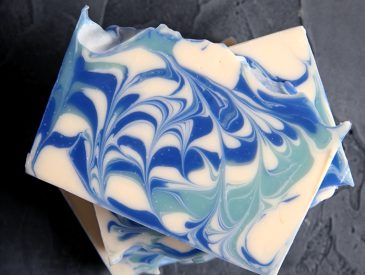
Alpine Swirl Cold Process Soap
New Alpine Frost Fragrance Oil will be your go-to winter scent. The notes of eucalyptus, sparkling icicle, amber, and musk inspired this cold process soap.
Ingredients
- 10 ″ Silicone Loaf Mold
- Hanger Swirl Tool
- 3.5 oz. Avocado Oil 10%
- 1 oz. Castor Oil 2.8%
- 8.8 oz. Coconut Oil 25.1%
- 8.8 oz. Olive Oil 25.1%
- 8.8 oz. Palm Oil 25.1%
- 4.2 oz. Rice Bran Oil 12%
- 4.9 oz. Sodium Hydroxide Lye
- 10.4 oz. Distilled Water 10% water discount
- 1.75 oz. Alpine Frost Fragrance Oil
- Titanium Dioxide
- Ultramarine Blue Pigment
- Neon Blue Raspberry Colorant
Instructions
COLORANT PREP: Disperse 1 teaspoon of titanium dioxide into 1 tablespoon of a lightweight liquid oil such as sunflower or sweet almond. Then in separate containers, disperse 1 teaspoon of Ultramarine Blue Pigment and 1 teaspoon of Neon Blue Raspberry Colorant into 1 tablespoon lightweight liquid oil. Use a mini mixer to get rid of clumps. Optional: To ensure the titanium dioxide blends smoothly into the soap, we recommend micronizing it before dispersing it in oil. Use a coffee grinder to break up any clumps of color and prevent streaks of white from showing in the final soap. We like to use a coffee grinder that has a removable stainless steel mixing area for easy cleaning.
FRAGRANCE PREP: In a glass fragrance oil-safe container, measure out 1.75 ounces of Alpine Frost Fragrance Oil and set aside.
SAFETY FIRST: Suit up for safe handling practices. That means goggles, gloves, and long sleeves. Make sure kids, pets, other distractions, and tripping hazards are out of the house or don’t have access to your soaping space. Always soap in a well-ventilated area.
- Slowly and carefully add 4.9 ounces of lye to 10.4 ounces of distilled water. Gently stir until the lye has fully dissolved. Set it aside to cool. If you’d like a harder bar of soap that releases faster from the mold, you can add sodium lactate to the cooled lye water. Use 1 teaspoon of sodium lactate per pound of oils in the recipe. For this recipe, you’d add 2 teaspoons sodium lactate.
- Melt and combine 3.5 ounces of avocado oil, 1 ounce of castor oil, 8.8 ounces of coconut oil, 8.8 ounces of olive oil, 8.8 ounces of palm oil (remember to fully melt the entire container of palm oil before portioning), and 4.2 ounces of rice bran oil into a large mixing bowl. Once the lye water and the oils have cooled to 130 degrees F or below (and are ideally within 10 degrees of each other), add the lye water to the oils and stick blend the mixture to a very thin trace.
- Split the soap into three separate containers and add the following colors. Use a whisk to mix them in.<br>Container A (300 mL ): 1.5 teaspoons dispersed Neon Blue Raspberry Colorant<br>Container B (300 mL): 2 teaspoons dispersed Ultramarine Blue Pigment<br>Container C (remaining soap): All dispersed titanium dioxide
- Add the 1.75 ounces of Alpine Frost Fragrance Oil to each container proportionally – it’s okay to eyeball it. Use a whisk to mix in the fragrance.
- Pour a small amount of the white soap into the mold – just enough to cover the bottom. Then alternate pouring small amounts of the dark blue, white, and light blue soap into the mold at varying heights. That helps the soap drop to different areas of the mold rather than sitting on top and creating layers. Don’t worry about being too precise when you’re pouring. Tip: Pouring white soap between the two shades of blue helps define the swirls.
- Continue pouring the soap into the mold. Save a very small amount of each color for the top.
- Insert the Hanger Swirl Tool into one side of the mold. Then, use loop-de-loop motions to swirl the soap. There is no right or wrong way to do this necessarily, but different motions and patterns will result in slightly different looking swirl. Some loops should be big and some small. Varying the direction (horizontal versus vertical) also creates a more complex swirl. Once you’ve swirled the soap about 7-10 times, remove the Hanger Swirl Tool by bringing it up and out on one side of the mold.
- Pour or plop (depending on your trace – ours was quite thick at this point) dollops of the remaining soap on top. Don’t worry too much about the placement of each color.
- Use the back of a spoon to create peaks and divots into the soap. Have fun with the texture – there is no right or wrong way to do it.
- Once you’re happy with the top, spritz with 99% isopropyl alcohol. We placed this soap on a heating pad for about 1 hour to help promote gel phase. Allow the soap to stay in the mold for 1-3 days (depending if you used sodium lactate or not). Unmold and cut into bars. Allow the bars to cure for 4-6 weeks and enjoy!
Tried this recipe?Let us know how it was!