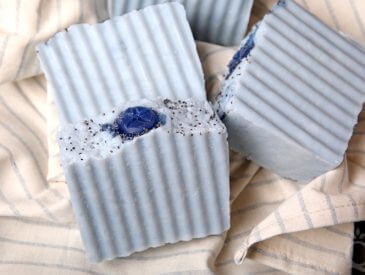
Blueberry Hot Process Soap Tutorial
This hot process soap is inspired by new Blueberry Thyme Fragrance Oil.
Ingredients
Embeds:
- Small 9 Ball Silicone Mold
- 2 oz. LCP Clear Melt and Pour Soap Base
- Ultramarine Blue Color Block
- Black Oxide Color Block
Base:
- 2 lb. Wood Loaf Mold
- Silicone Liner for 2 lb Wood Loaf Mold
- 22 oz. Lots of Lather Quick Mix
- 3.2 oz. Sodium Hydroxide Lye
- 7.3 oz. Distilled Water
- 1.3 oz. Blueberry Thyme Fragrance Oil
- Ultramarine Blue Pigment
- Poppy Seeds
Instructions
Make the Embeds
- Chop 2 ounces of LCP Clear Melt and Pour Soap Base into small uniform pieces. Place the soap and a shaving of Ultramarine Blue Color Block into a heat-safe container and melt using 5-10 second bursts. Because it’s such a small amount of soap, be careful to not burn it. Once melted, add more Ultramarine Blue Color Block if necessary. Then, add very small shavings of the Black Oxide Color Block to achieve a dark and saturated blue.
- Carefully pour the soap into each cavity of the Small 9 Ball Silicone Mold. Each cavity should be filled to the very top. Allow the soap to fully cool and harden.
- Once the soap is hard, remove each embed from the mold. Carve five points into the flat side of the embed to resemble a blueberry. We found the Clean Up Tool worked well for this step. NOTE: We placed 6 blueberry embeds into the top of the soap, which created large bars. You can make more or fewer embeds depending on how large you want the bars to be.
Make the Base
FRAGRANCE PREP: Measure 1.3 ounces of Blueberry Thyme Fragrance Oil into a small glass container and set aside.
COLOR PREP: Disperse 1/2 teaspoon of Ultramarine Blue Pigment into 1/2 tablespoon of lightweight liquid oil. Use a mini mixer to get rid of clumps and set aside. Have poppy seeds and embeds nearby.
SAFETY FIRST: Suit up for safe handling practices. That means goggles, gloves, and long sleeves. Make sure kids, pets, other distractions, and tripping hazards are out of the house or don’t have access to your soaping space. Always soap in a well-ventilated area.
- Slowly and carefully add the 3.2 ounces of lye to the 7.3 ounces of distilled water and gently stir until the lye has fully dissolved and the liquid is clear. Set aside to cool. Once cooled to about 130° F , add 0.7 ounces of sodium lactate to the lye water. Sodium lactate is used in hot process at 3% of the oil weight to help produce a smoother bar.
- Fully melt the entire bag of Lots of Lather Quick Mix until it’s completely clear and there’s no cloudiness. Shake the bag to mix up all the oils. Measure 22 ounces into your Crock-Pot and turn it on. NOTE: The heat setting you use may vary depending on your cooking vessel. We’ve cooked hot process soap on low and high heat with equally good results. For this recipe, we used the high heat setting for a faster cook time. If you’re making hot process soap in your cooking vessel for the first time, start with the low setting. Next time try the high setting and see which you prefer.
- Slowly add the lye water to the oils. Make sure the mixture does not fill up more than half of the pot or cooking vessel. Tap the stick blender on the bottom of the pot to release air bubbles and begin to blend.
- Mix with the stick blender until a thick trace is achieved.
- Put the lid on the Crock-Pot and allow the soap to start cooking. After about 10 minutes, check the soap. Starting from the outside, the texture and color of the soap will start to change into a glossy, slightly Vaseline-like texture. Stir the soap to ensure even cooking. Place the lid back on and allow it to cook for another 5-7 minutes. NOTE: Don’t be surprised if the soap starts to grow in volume. Don’t leave your soap unattended in the first 10 minutes of cook time for this reason. If the soap gets too high in the pot, wearing gloves, take the pot off heat and stir like crazy.
- The batch is ready when it’s the texture of glossy mashed potatoes. This may take up to three more 5-10 minute sessions, depending on how hot your Crock-Pot is. When you think it’s ready, use a pH strip to test the levels. Place a small amount of the soap into a cup of distilled water and stir. Dip the pH strip into the water – it should be below 10. Be sure not to overcook the soap, you don’t want it too dry for the next steps.
- Add 1/2 teaspoon of dispersed Ultramarine Blue Pigment directly to the soap and stir until it’s fully combined.
- Add all of the 1.3 ounces of Blueberry Thyme Fragrance Oil and stir to fully combine.
- Working quickly, spoon the soap into the mold. Tap the mold on the counter firmly to help it settle. Once all the soap is in the mold, use a spoon or gloved hands to smooth the top.
- Insert the blueberry embeds into the soap. We used 6 embeds, which created nice thick bars. Depending on how many embeds you make, you can place them closer together to create smaller bars.
- Working very quickly, sprinkle poppy seeds on top and use your hands to press them into the soap. Sprinkle on more than you want, because some will fall off when the bars are cut.
- Allow the soap to stay in the mold for at least 24 hours. Unmold and cut into bars. This soap is ready to use right away, but will last longer in the shower after at least a 2 week cure time.
Tried this recipe?Let us know how it was!