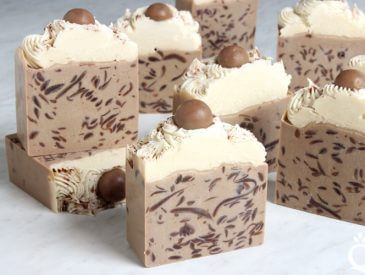
Eggnog Cold Process Soap DIY
This recipe is scented with new Spiked Eggnog Fragrance Oil, which has notes of vanilla, nutmeg, caramel, and rum.
Ingredients
Embeds
- 2 Small 9 Ball Silicone Molds
- 1 oz. Cocoa Butter
- 2.5 oz. Coconut Oil
- 4 oz. Olive Oil
- 2.5 oz. Palm Oil
- 1.5 oz. Sodium Hydroxide Lye 2% superfat so they harden more quickly
- 3.3 oz. Distilled Water
- 1 Tbsp. Cocoa Powder
Base
- 5 Pound Mold with Sliding Bottom
- Silicone Liner for 5 Pound Wood Mold
- 4 Egg Yolks
- 5.4 oz. Cocoa Butter
- 13.5 oz. Coconut Oil
- 21.6 oz. Olive Oil
- 13.5 oz. Palm Oil
- 7.6 oz. Sodium Hydroxide Lye 5% superfat
- 17.8 oz. Distilled Water
- 3.5 oz. Spiked Eggnog Fragrance Oil
- Disposable Frosting Bag
- 4 B Frosting Bag
Instructions
Make the Embeds
SAFETY FIRST: Suit up for safe handling practices. That means goggles, gloves, and long sleeves. Make sure kids, pets, and other distractions and tripping hazards are out of the house or don’t have access to your soaping space. Always soap in a well-ventilated area.
- Slowly and carefully add the lye to the water and gently stir until the lye has fully dissolved and the liquid is clear. Set aside to cool. If you’d like a harder bar of soap that releases faster from the mold, you can add sodium lactate to the cooled lye water. Use 1 teaspoon of sodium lactate per pound of oils in the recipe. For this recipe, you’d add .5 teaspoons sodium lactate.
- In a container large enough to fit all your ingredients, combine and melt the coconut oil, cocoa butter, olive oil, and palm oil (remember to fully melt then mix your entire container of palm oil before portioning). Add the cocoa powder directly to the oils, and stir to get rid of chunks. Once the lye water and the oils have cooled to 130 degrees or below (and are ideally within 10 degrees of each other), add the lye water to the oils and stick blend until a very thin trace. Because this recipe contains plenty of cocoa butter, this will take about 30-60 seconds of blending and stirring with the stick blender.
- Once the oils and lye solution are completely mixed, carefully pour the soap batter into each cavity of both Small 9 Ball Silicone Molds. Once each cavity is full, pour the remainder into a separate mold. The exact shape of the mold is not extremely important because this soap will be shredded once it’s firm. We poured our leftover batter into the 12 Cavity Rectangle Silicone Mold.
- Allow the soap to stay in the mold for 1-2 days. If you did not use sodium lactate, it may take an extra day to remove the soap. Remove the soap from each mold. Set the small spheres aside. Then, use a cheese grater to grate the soap poured into the “extra” mold. These shreds will be used in the base of the soap and the spheres will go on top. Set all the soap aside while you prep the ingredients for the base.
Create the Base
COLOR PREP: To ensure that the titanium dioxide blends smoothly into the soap batter, we recommend micronizing it before dispersing it in oil. Please note this is an optional tip but it does help with the titanium dioxide clumping in the soap. To micronize the colorant, simply use a coffee grinder to break up any clumps of color and prevent streaks of white from showing in the final soap. We like to use a coffee grinder that has a removable stainless steel mixing area for easy cleaning. Disperse 6 teaspoons of the titanium dioxide into 4 tablespoons of sunflower or sweet almond oil (or any other liquid oil). Use a mini mixer to get rid of any clumps. The color dispersion is a little more concentrated than usual to avoid adding too much extra oil. In a separate container, mix 1/2 teaspoon of Yellow Oxide into 1/2 tablespoon lightweight liquid oil. Use a mini mixer to get rid of any clumps.
FRAGRANCE PREP: Measure 3.5 ounces of Spiked Eggnog Fragrance Oil into a small glass container and set aside.
FROSTING BAG PREP: Cut off the tip of the disposable frosting bag and insert the frosting tip. Set aside.
EGG PREP: Separate four egg yolks from the whites. Place the egg yolks into a small container and whisk them together until smooth.
- Slowly and carefully add the lye to the water and gently stir until the lye has fully dissolved and the liquid is clear. Set aside to cool. If you’d like a harder bar of soap that releases faster from the mold, you can add sodium lactate to the cooled lye water. Use 1 teaspoon of sodium lactate per pound of oils in the recipe. For this recipe, you’d add 3.5 teaspoons sodium lactate.
- Melt and combine the coconut oil, cocoa butter, olive oil, and palm oil (remember to fully melt then mix your entire container of palm oil before portioning) into a large container. Allow the oils to cool to about 90 ° F. Then, add a small amount of the oils (about 1 ounce) to the egg yolks and quickly whisk. You want to slowly raise the temperature of the egg yolks. If the oil is added to the egg yolks while it’s too hot, you’ll have chunks of cooked eggs. Keep adding small amounts of oil and whisking until the egg yolks reach a temperature of about 80 ° F and have a smooth, liquid texture. Set the eggs aside.
- Check the temperature of the lye solution. It should be fairly cool – about 90 ° F or below. Slowly pour the lye solution into the large container of oils and begin pulsing with the stick blender. Use the blender to stir the oils in addition to pulsing the blender. Continue blending for about 30-60 seconds, or until the mixture looks like thin pudding.
- Slowly begin pouring the egg mixture into the soap batter, while using your other hand to pulse the stick blender to quickly incorporate the eggs. Continue this process until all the egg yolks have been added.
- Once all the egg yolks have been added, pour about 800 mL of the batter into a separate container. Add 1 tablespoon of dispersed titanium dioxide into this container. Use a whisk to fully mix in the titanium dioxide and set the soap aside. This will be the frosting for the top.
- Add the remaining dispersed titanium dioxide to the other large container of soap. Use a whisk to fully mix in the colorant. Then, add 1/4 teaspoon of dispersed Yellow Oxide and mix in fully with a whisk.
- Pour all the measured Spiked Eggnog Fragrance Oil into the large container of soap and mix in. Do not add any fragrance to the 800 mL of soap. The smaller container of soap will be the frosting and should be white. Adding fragrance oil to this soap will cause it to discolor. If the large container of soap is still a very thin texture, pulse the soap with the stick blender a few times to thicken it.
- Add all of the shredded brown soap to the large container, and use a whisk or spatula to fully mix in.
- Pour all of the soap in the large container into the mold. Use a spoon or spatula to spread the soap evenly throughout the mold. Tap the mold on the counter to help get rid of bubbles.
- Check the texture of the white soap. This soap needs to be thick enough to hold shape but smooth enough to pipe. Test the consistency by adding a small amount of the soap to the prepped bag and piping a dollop into the mold. If it holds its shape, you’re ready to pipe. If the soap falls flat and loses the details of the frosting tip, allow the soap to sit in the container for a few more minutes. Once the soap is thick enough to pipe, transfer a portion of the soap into the frosting bag.
- Begin by piping small dollops of soap down the middle of the mold. Then, pipe dollops on either side to create rows of three dollops.
- Finally, pipe a larger dollop of soap on top of the center dollop to create height. There is no right or wrong way to pipe soap frosting – just have fun with it. If you need some piping inspiration, Katie of Royalty Soaps creates amazing frosting on her bars. Ours pale in comparison!
- Once you’re done piping, place a soap sphere embed into the center of each dollop. Then, sprinkle the top with a light dusting of cinnamon powder. Save the leftover embeds for your next batch. Note: Cinnamon can cause irritation, so if you have sensitive skin you can use a sprinkling of mica instead. Cappuccino Mica is a good option.
- Spritz the top of the soap with 99% isopropyl alcohol to help prevent soda ash. This soap needs to be kept cool, so don’t insulate it. It can be left at room temperature of about 70 ° F or cooler. If you live in a hot climate you may want to place the soap in the fridge or freezer for 5-24 hours. Then, remove from the fridge or freezer and allow it to stay in the mold for about 2 days. Unmold and cut into bars. Allow the soap to cure for 4-6 weeks and enjoy!
Tried this recipe?Let us know how it was!