Emerald Swirl Cold Process Tutorial
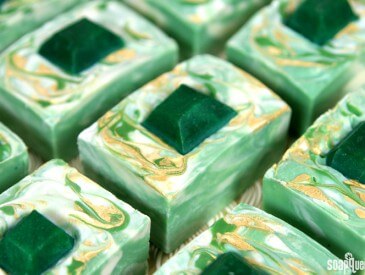
This Emerald Swirl Cold Process Soap features a melt and pour embeds, mica painting and an in-the-pot swirl!
Ingredients
- 12 Cavity Rectangle Mold
- 2.1 oz. Avocado Butter
- 4.2 oz. Canola Oil
- .8 oz. Castor Oil
- 10.5 oz. Coconut Oil
- 2.1 oz. Green Tea Seed Oil
- 12.6 oz. Olive Oil
- 9.7 oz. Palm Oil
- 12.4 oz. Distilled Water 10% water discount
- 5.9 oz. Sodium Hydroxide Lye
- 2.5 oz. Green Fig Fragrance Oil
- Hydrated Chrome Green Pigment
- Green Chrome Oxide Pigment
- Titanium Dioxide
- Gold Sparkle Mica
- 9 Cube Soap Silicone Mold
- 10 oz. LCP Clear Melt and Pour Base
- Shamrock Green Mica
- Fine Iridescent Glitter
- Optional: 99% Isopropyl Alcohol
Instructions
Make the Embeds: Chop and melt 10 oz. of LCP Clear Melt and Pour Base in the microwave using 20 second bursts. Once melted, add 1 tsp. Shamrock Green Mica and about 1/8 of a tsp. of Fine Iridescent Glitter. Use a spoon to fully incorporate in the colorants, mixing until there are no clumps. Pour the soap into two cavities of the 9 Cube Soap Silicone Mold, and spritz with alcohol to disperse any bubbles. Allow to fully cool and harden. Once hard, remove from the mold and cut into emerald shapes. Set aside until you are ready to soap.
SAFETY FIRST: Suit up for safe handling practices! That means goggles, gloves and long sleeves. Make sure kids, pets, and other distractions and tripping hazards are out of the house or don’t have access to your soaping space. Always soap in a well-ventilated area.
COLOR PREP: To ensure that the Titanium Dioxide blends smoothly into the soap batter, we recommend micronizing it before dispersing it in oil. Please note this is an optional tip but it does help with the titanium dioxide clumping in the soap =) To micronize colorant, simply use a coffee grinder to blend the colorant to break up any clumps of color and prevent streaks of white from showing in the final soap. We like to use a coffee grinder that has a removable, stainless steel mixing area for easy cleaning. Then, disperse 1 teaspoons of the colorant into 1 tablespoons of sunflower or sweet almond oil (or any other liquid oil). Then in separate containers, disperse 1 teaspoon of the Chrome Green Oxide, Hydrated Chrome Green Oxide and Gold Sparkle Mica in 1 Tbs. lightweight liquid oil. Use a mini mixer to disperse any clumps.
- Slowly and carefully add the lye to the water and gently stir until the lye has fully dissolved and the liquid is clear. Set aside to cool.
- Melt and combine the coconut oil, olive oil, canola oil, castor oil, pumpkin seed oil, shea butter and palm oils (remember to fully melt then mix your entire container of palm oil before portioning). Once the lye water and the oils have cooled to 130 degrees or below (and are ideally within 10 degrees of each other), add the lye water to the oils and stick blend until thin trace. If you’d like a harder bar of soap that releases faster from the mold, you can add sodium lactate to the cooled lye water. Use 1 teaspoon of sodium lactate per pound of oils in the recipe. For this recipe, you’d add about 2.5 sodium lactate.
- Once the batter has reached a light trace, pour off about 100 mL into a small container and set aside. This soap will be used later on the top. Then, split the remaining batter in half.
- To one container, add 2 Tbs. dispersed Titanium Dioxide and use a whisk to fully mix in the colorant.
- To the other large container, add 1 tsp. dispersed Hydrated Chrome Green and 1 tsp. dispersed Chrome Green Oxide. Use a whisk to fully incorporate the colorants.
- Split the Green Fig Fragrance Oil evenly between the the two containers. It’s okay to eyeball it! Use a whisk to fully mix in. At this point, the soap should be at about a medium trace. If it’s still very thin, stick blend the white and green soap for several seconds to thicken slightly.
- It’s time to make the in-the-pot swirl! Pour the green soap into the white soap in four places: 12 o’clock, 3 o’clock, 6 o’clock and 9 o’clock. Pour steadily from a high point to get the color all the way to the bottom of the container. Then, use a chopstick or dowel twice through the soap, hitting each entry point. Click here to watch an in-the-pot swirl in action!
- Place the silicone mold on a flat surface, like a cutting board. This will help you to transfer the mold after pouring the soap, and tap the mold on the counter to release bubbles. Pour the soap into each cavity. After pouring about half of the cavity, tap the mold on the counter to help disperse the soap evenly in the cavities. If you need to, use a the back of the spoon to smooth the top of the soap.
- Add 1 tsp. of dispersed Chrome Green Oxide to the small container of soap portioned off earlier. Use a whisk to fully mix in the color.
- Once the top of each cavity is smooth, use a dropper to place drops of the Gold Sparkle Mica oil mixture onto the top of the soap. I placed about 6-8 drops of gold per cavity, but how much you use is up to you! Don’t worry too much about where the drops go, just try to disperse them evenly on the bar. Then, use the dropper to add drops of the highly pigmented green soap on the bars as well.
- Use a chopstick or dowel to swirl the dots of gold mica and dark green soap. I used an S-shape down the length of the mold, but feel free to swirl however you’d like!
- Press an emerald melt and pour embed into the center of each cavity. Lightly spritz the top of the soap with 99% isopropyl alcohol to prevent soda ash. Don’t spray too much, as this can cause the mica painting to disperse. Because the melt and pour pieces may melt if the soap gets too hot, do not insulate the soap. Allow to harden in the mold for 3-5 days. I found this soap took a little bit longer to harden. Once hard, remove from the mold and allow to cute for 4-6 weeks. The LCP melt and pour soap does prevent glycerin dew, but may still develop a small amount while the cold process soap cures. We found it easy to wipe away the dew. =)
Tried this recipe?Let us know how it was!