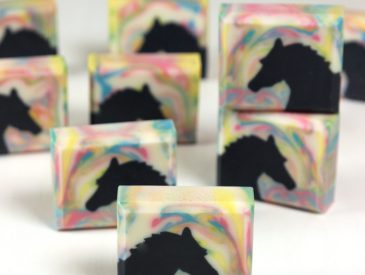
Horse Sculpted Layers Cold Process Soap
This soap uses the Sculpted Layers technique made popular by Claudia of Om Nom Soap to create a horse silhouette in the center of the bar.
Ingredients
- 5 Pound Mold with Sliding Bottom
- Silicone Liner for 5 lb Wood Mold
- Horse Silhouette Template
First Layer:
- 40 oz. Basic Quick Mix
- 13.2 oz. Distilled Water
- 5.7 oz. Sodium Hydroxide Lye
- 2 oz. Apple Sage Fragrance Oil
- Titanium Dioxide
- Buttercup Mica
- Magenta Mica
- Blue Slushy Mica
Second Layer:
- 40 oz. Basic Quick Mix
- 13.2 oz. Distilled Water
- 5.7 oz. Sodium Hydroxide Lye
- 2 oz. Apple Sage Fragrance Oil
- Black Oxide
Third Layer:
- 20 oz. Basic Quick Mix
- 6.6 oz. Distilled Water
- 2.8 oz. Sodium Hydroxide Lye
- 1 oz. Apple Sage Fragrance Oil
- Titanium Dioxide
- Buttercup Mica
- Magenta Mica
- Blue Slushy Mica
Instructions
SCULPTING “TOOL” PREP: First, you need to prep the tools to “sculpt” the soap. Arguably, this might be the trickiest part of the whole process. Some designs require multiple sculpting pieces that are incredibly intricate and complicated; check out all the pieces Claudia made for her soap! So awesome. I tried to keep mine rather simple and created three pieces. To make the pieces you need cardboard, clear plastic packing tape and three printed horse images.<br>The first piece I made was the entire horse image, which was placed on one end of the mold. I used this as a guide for pouring the soap into the mold to the appropriate heights (shown below). To make this piece, I cut the horse image and taped it to cardboard. Then, I cut the cardboard to include a lip on top to keep it in place.<br>The other two pieces were made in a similar way. Print the horse image on a piece of paper, cut the cardboard to fit inside the width of the inside of the mold, and cut. Then, wrap the whole thing in clear plastic tape. This prevents it from becoming soggy when it comes in contact with the soap batter. On the top lip, I included a small piece that hangs over the side of the mold (shown on the right in the image below). The way, when you slide the piece down the length of the mold, it will stay in the same place with each pass. This is an important part of this technique; each pass needs to go in the exact same place, or it will muddle the shape. For the first piece, cut around the top of the horse head, ending where the nose begins to curve. This will be used to create the first layer. The second piece needs to “complete” the first. Cut out the entire horse head, including the nose, leaving behind the spot under the nose. You can see what the two pieces should look like below. Set your pieces aside to prep the remaining ingredients.
SAFETY FIRST: Suit up for safe handling practices! That means goggles, gloves and long sleeves. Make sure kids, pets, and other distractions and tripping hazards are out of the house or don’t have access to your soaping space. Always soap in a well-ventilated area.
*NOTE: This recipe involves three different batches of soap. You can either prep all three batches at the same time, or one after the other after making the step before. Personally, I recommend prepping all three steps at the same time. This means prepping three bowls of oil and three containers of lye. All the colorants can be prepped before, and the fragrance oil can be weighed in the same glass container before pouring to save on dishes. Prepping everything at once ensures you don’t let the layer of soap below set too long and become too thick, which makes it impossible to smoothly drag your shape through the mold. This means the lye for the second and third layer will be on the cooler side, but I found that to work fine. If you prefer prepping your ingredients in a different order, feel free.
COLOR PREP: To ensure that the Titanium Dioxide blends smoothly into the soap batter, we recommend micronizing it before dispersing it in oil. Please note this is an optional tip but it does help with the titanium dioxide clumping in the soap. =) To micronize colorant, simply use a coffee grinder to blend the colorant to break up any clumps of color and prevent streaks of white from showing in the final soap. We like to use a coffee grinder that has a removable, stainless steel mixing area for easy cleaning. Disperse 2 teaspoon of the colorant into 2 tablespoons of sunflower or sweet almond oil (or any other liquid oil). Then in a separate containers, disperse 1 teaspoon Buttercup Mica, 1 teaspoon Magenta Mica and 1 teaspoon Slushy Blue Mica into 1 tablespoon of oil. Finally, disperse 1/2 teaspoon Black Oxide into 1/2 tablespoon oil. Use a mini mixer to help get rid of any clumps.
FRAGRANCE OIL PREP: In a glass, fragrance oil safe container, measure 2 ounces of Apple Sage Fragrance Oil. Set aside. This is the fragrance for the first layer. Once you pour the fragrance into the soap, keep the cup around to measure the fragrance oil for the following batches.
- Slowly and carefully add the lye to the water for all three batches, and gently stir until the lye has fully dissolved and the liquid is clear. Set aside to cool. You will have three containers of lye, with the amounts below. Once cooled, add sodium lactate to the lye water for a bar of soap that releases faster from the mold.
-Batch One Lye Solution: 13.2 oz. Distilled Water + 5.7 oz. Sodium Hydroxide Lye + 2.5 tsp. Sodium Lactate (optional)
-Batch Two Lye Solution: 13.2 oz. Distilled Water + 5.7 oz. Sodium Hydroxide Lye + 2.5 tsp. Sodium Lactate (optional)
-Batch Three Lye Solution: 6.6 oz. Distilled Water + 2.8 oz. Sodium Hydroxide Lye + 1 tsp. Sodium Lactate (optional) - Fully melt the entire bag of Basic Quick Mix until there is no cloudiness. Give it a good shake to mix all the oils, and measure out 40 ounces into one soaping bowl, 40 ounces into a second and 20 ounces into a third. Set aside the bowls of oil for batch two and three. Once the lye water and the oils for batch one have cooled to 130 degrees or below (and are ideally within 10 degrees of each other), add the batch one lye water to the oils and stick blend until thin trace.
- Once you have a thin trace, add 1 Tbs. dispersed titanium dioxide into the entire batch. Split off three containers of 200 mL. Add the dispersed colorants in the following amounts below, and use a whisk to fully incorporate the colorants.
-Container A (200 mL): 1 tsp. dispersed Buttercup Mica
-Container B (200 mL): 1/2 tsp. dispersed Slushy Blue Mica
-Container C (200 mL): 1/2 tsp. Magenta Mica - Add the measured Apple Sage Fragrance Oil into each container proportionally, it’s okay to eyeball it. Use a whisk to mix in the fragrance oil. If the batter is still extremely thin, give the white soap a short burst or two with the stick blender to thicken slightly. The soap should be a thin-medium trace.
- Create an In-The-Pot Swirl by pouring the pink, yellow and blue soap into various areas of the white bowl of soap. Pour from various heights above the mold. This helps the colors break through the white, and reach the bottom of the bowl as well as the top. Once the colors have all been poured, use a chopstick or dowel to swirl the soap in a circular motion three to four times.
- Pour the soap into the mold. The soap will not fill up the mold all the way; fill up to the middle-ish of the horse nose. Give the mold a tap on the counter to help release air bubbles.
- Now, it’s time to wait for the soap to firm and harden. The soap should be firm enough to hold its shape, but thin enough for the soap to be scraped out smoothly. It’s a little hard to know when that “perfect” texture has been achieved. I tested every 3-5 minutes or so by scraping a small amount of the very top of the soap with a spoon. It is better to start scraping out the extra soap sooner rather than later. If the soap is not thick enough to hold any shape, let it harden for a few more minutes. But, if the soap is too thick, there is no going back. For this recipe, I found waiting about 8 minutes was the perfect amount of time for the first layer. Your soap may require more or less time, so keep an eye on it.
Once the soap is an appropriate texture, insert the cardboard shape with the horse nose into one edge of the soap, and begin pulling it through the mold. Place the extra soap into a separate mold if you’d like to save it. The first few passes with the cardboard shaper will be a little awkward and messy, but that’s okay! This process will begin to form the top of the horse’s outline including the mane, ears, and top of the nose.
Continue sliding the shaper through the mold. I recommend sliding it in both directions; it will help pull away every little bit of soap for the cleanest image. As you can see below, the shape of the horse is starting to come together! Once you pull the scraper away and it’s no longer pulling soap out, you know it’s done. Allow this layer to sit and harden for 10-15 minutes. The bottom layer should be firm enough to support a thin layer of soap on top without it squishing the small details of the mane, and general shape of the nose.
BATCH #2
FRAGRANCE PREP: Measure 2 ounces of the Apple Sage Fragrance Oil into a glass, fragrance oil safe container, set aside.
- Once the first layer is firm, it’s time to make the second layer. Heat up the bowl of oils for batch two if necessary to 120-130 ° F. Most likely, the lye water will be a little on the cool side, but that’s okay. Add the batch two lye water to the oils and stick blend until thin trace.
- Add 1 teaspoon dispersed Black Oxide, and the measured Apple Sage Fragrance Oil. Use a whisk to fully mix in the colorant and fragrance oil.
- While the soap is still thin, very gently and carefully pour the soap into the mold. Don’t pour from too high above the mold, or this can cause the soap to “crush” the bottom layer which could ruin the shape. Continue to pour the soap into the mold until completely full. Pour any extra soap into a separate container.
- Allow the black layer of soap to sit and harden for about 7-10 minutes. The exact time of your batch might vary, as the temperature of your soap will most likely be different, causing it to set up at a slightly different rate. Once the soap is firm enough to hold a shape, insert the small cardboard shape at one end, and slide it down the length of the mold. Place the “extra” soap into a separate mold. I had about 16 ounces of “discard” soap. Be careful to not let the cardboard shape “wiggle” too much as you drag it across, which will affect the shape of the horse image. Once all the “extra” black soap has been removed and the shape is nice and clean, it’s time for the third and final layer!
BATCH #3
FRAGRANCE PREP: Measure 1 ounce of the Apple Sage Fragrance Oil into a glass, fragrance oil safe container, set aside.
- Heat up the bowl of oils for batch three if necessary, to about 130 ° F. Most likely, the lye water will be a little on the cool side, but that’s okay. Add the batch three lye water to the oils and stick blend until thin trace.
- Once the soap is at a thin trace, add 1/2 Tbs. dispersed titanium dioxide into the entire batch. Split off three containers of soap at 100 mL each and add the following dispersed colorants below. Use a whisk to blend them in completely. Then, add the measured Apple Sage Fragrance Oil into the containers of soap proportionally, it’s okay to eyeball it. Use a whisk to mix in.
-Container A (100 mL): 1/2 tsp. dispersed Buttercup Mica
-Container B (100 mL): 1/4 tsp. dispersed Slushy Blue Mica
-Container C (100 mL): 1/4 tsp. Magenta Mica - Just like the first batch, pour the pink, blue, and yellow (it will look orange!) soap into the bowl of white soap. Pour from varying heights to allow the soap to break into various spots of the bowl. Once all the colors have been poured, use the dowel or chopstick to fully swirl the soap in a circular motion several times.
- Carefully pour the soap into the mold, starting by filling “empty” area of the mold where the black soap was scraped out. Continue to fill the mold completely, covering the top of the black soap. Use the back of a small spoon to even out the top of the soap if necessary. Spritz the mold with 99% isopropyl alcohol, and allow to sit in the mold for about 2-3 days. I did not cover the soap, as it would have disrupted the top. If your soaping area is very cold, create a “cardboard tent” over the top to help insulate the soap for 24 hours.
- After about 2-3 days, carefully remove from the mold, and cut into bars. I found that some bars turned out a little bit better than others, and you can very faintly see the difference between the first multi-colored layer, and the last because the swirl is slightly different.
Tried this recipe?Let us know how it was!