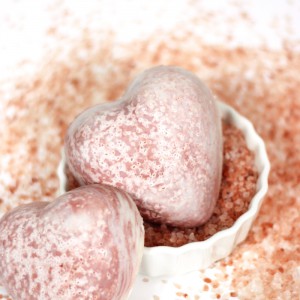
Lavender and Rose Pink Salt Bars
These salt bars are made with lavender essential oil and rose clay to create a bar of soap that really shows the love!
Ingredients
- Simple Heart Mold three molds
- 10 oz. Coconut Oil 50%
- 4 oz. Olive Oil 20%
- 4 oz. Palm Oil 20%
- 1.4 oz. Sweet Almond Oil 7%
- 0.6 oz. Castor Oil 3%
- 3 oz. Sodium Hydroxide Lye
- 6.6 oz. Distilled Water
- 0.9 oz. Hungarian Lavender Essential Oil
- 2 cups Pink Sea Salt Small
- Rose Clay
- Titanium Dioxide
Instructions
SAFETY FIRST: Suit up for safe handling practices! That means goggles, gloves and long sleeves. Make sure kids, pets, and other distractions and tripping hazards are out of the house or don’t have access to your soaping space. Always soap in a well-ventilated area.
FRAGRANCE PREP: Measure .9 ounces of the Hungarian Lavender Essential Oil in a glass, essential oil safe container. Set aside.
COLOR PREP: To ensure that the Titanium Dioxide blends smoothly into the soap batter, we recommend micronizing it before dispersing it in oil. Please note this is an optional tip but it does help with the titanium dioxide clumping in the soap. =) To micronize colorant, simply use a coffee grinder to blend the colorant to break up any clumps of color and prevent streaks of white from showing in the final soap. We like to use a coffee grinder that has a removable, stainless steel mixing area for easy cleaning. Then, disperse 1 teaspoon of the colorant into 1 tablespoon of sunflower or sweet almond oil (or any other liquid oil). Then in a separate container, add 2 teaspoons rose clay and mix together with 2 tablespoons of distilled water. Clays are best dispersed in water rather than oil, because of their ability to absorb moisture.
- Slowly and carefully add the lye to the water and gently stir until the lye has fully dissolved and the liquid is clear. Set aside to cool.
- Melt and combine the coconut oil, olive oil, castor, sweet almond and palm oils (remember to fully melt then mix your entire container of palm oil before portioning). Once the lye water and the oils have cooled to 130 degrees or below (and are ideally within 10 degrees of each other), add the lye water to the oils and stick blend until thin trace. If you’d like a harder bar of soap that releases faster from the mold, you can add sodium lactate to the cooled lye water. Use 1 teaspoon of sodium lactate per pound of oils in the recipe. For this recipe, you’d add about 1 teaspoon sodium lactate.
- Once the batter has reached a thin trace, split off about 200 mL of the soap into a separate container. To this container, add 1 Tablespoon of the dispersed titanium dioxide and mix together with a whisk or spoon.
- To the other larger container of soap, add all the dispersed rose clay and mix together thoroughly with a spoon or whisk.
- Add the Hungarian Lavender Essential Oil to both containers proportionately; it’s okay to eyeball it! Use a whisk to thoroughly mix in the essential oil.
- Add 2 cups of the pink sea salt to the rose clay soap, and mix in with a whisk or spatula.
- Holding the white soap about six inches above the pot of rose clay soap, pour the white soap into various areas of bowl. Pouring from high above the bowl allows the white soap to break through to the bottom of the rose clay soap.
- Using a spoon, chopstick or dowel, give the soap one stir to help swirl the colors slightly. Don’t stir too much, you don’t wan to completely mix them!
- Pour the soap into each heart cavity in all three molds until completely full. You’ll have nine bars total. Tap the mold on the counter to release bubbles and settle soap evenly in the mold.
- Spritz the top with 99% isopropyl alcohol to help avoid soda ash. Allow the soap to harden in the mold for 2-3 days. Allow to cure for 4-6 weeks and enjoy!
Tried this recipe?Let us know how it was!