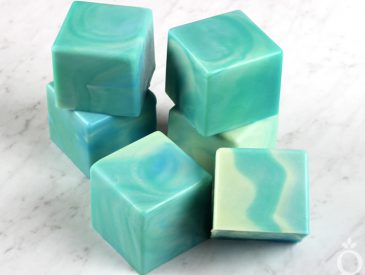
Lime LaCroix Soap Tutorial
This soap is made with and inspired by Lime LaCroix.
Ingredients
- 9 Cube Soap Silicone Mold
- 33 oz. Swirl Quick Mix
- 4.6 oz. Sodium Hydroxide Lye
- 10.9 oz. Flat Lime LaCroix
- 2.4 oz. Lime Fragrance Oil
- Blue Slushy Mica
- Kermit Green Mica
- Hydrated Chrome Green Colorant
- Aqua Pearl Mica
- Titanium Dioxide
Instructions
LA CROIX PREP (1-2 days before): Open one can of Lime LaCroix and allow it to sit out for 1-2 days to get rid of carbonation. The best way to test if the LaCroix is flat is to taste it. Once it no longer contains carbonation and you’re ready to soap, pour 10.9 ounces into a lye safe container.
COLOR PREP: In separate containers, disperse 1/2 teaspoon of titanium dioxide, Aqua Pearl Mica, Hydrated Chrome Green Pigment, and Slushy Blue Mica into 1/2 tablespoon sunflower or sweet almond oil (or any other liquid oil). In a separate container, disperse 1 teaspoon Kermit Green Mica into 1 tablespoon lightweight liquid oil. Use a mini mixer to get rid of clumps. OPTIONAL: To ensure that the titanium dioxide blends smoothly into the soap batter, we recommend micronizing it before dispersing it in oil. To micronize the colorant, simply use a coffee grinder to blend it. That breaks up any clumps of color and prevents streaks of white from showing in the final soap. We like to use a coffee grinder that has a removable stainless steel mixing area for easy cleaning.
FRAGRANCE PREP: Measure 2.4 ounces of Lime Fragrance Oil into a glass fragrance-oil-safe container. Set aside.
SAFETY FIRST: Suit up for safe handling practices. That means goggles, gloves, and long sleeves. Make sure kids, pets, other distractions, and tripping hazards are out of the house or don’t have access to your soaping space. Always soap in a well-ventilated area.
- Slowly and carefully add the lye to the LaCroix and gently stir until the lye has fully dissolved and the liquid is clear. Set aside to cool. If you’d like a harder bar of soap that releases faster from the mold, you can add sodium lactate to the cooled lye water. Use 1 teaspoon of sodium lactate per pound of oils in the recipe. For this recipe, you’d add 2 teaspoons of sodium lactate.
- Fully melt the entire bag of Swirl Quick Mix until it’s completely clear and there is no cloudiness. Shake the bag to mix up all the oils. Measure 33 ounces into your soaping bowl. Once the lye water and the oils have cooled to 130 degrees F or below (and are ideally within 10 degrees of each other), add the lye water to the oils and stick blend the mixture to a thin trace.
- Pour 200 mL of the soap batter into two separate containers. Then pour 400 mL of soap into another container. Add the following amounts of dispersed colorants to each container of soap and use a whisk to fully mix in the colorants.Container A (200 mL): 1 tsp. Blue Slushy MicaContainer B (200 mL): 1 tsp. Aqua Pearl MicaContainer C (400 mL): 2 tsp. Kermit Green + 1/2 tsp. Hydrated Chrome Green PigmentContainer D (remaining soap in largest container): 1 tsp. titanium dioxide + 1 tsp. Kermit Green
- Add the Lime Fragrance Oil proportionally to each container (it’s okay to eyeball it) and use a whisk to mix it in thoroughly. The soap batter should be thin enough to pour but thick enough so the colors don’t muddle when mixed together. If the soap batter is extremely thin, give it a few pulses with the stick blender to slightly thicken.
- Pour all of the light blue soap into the bowl of light green soap, concentrating it on one side. Pour from various heights above the bowl to distribute the blue soap throughout the green soap in the bowl.
- Pour all of the aqua soap into the large bowl, concentrating it on the other side of the bowl. Pour from various heights above the bowl to distribute the aqua throughout the green soap in the bowl.
- Finally, pour all of the darker green soap into the bowl at various heights. Concentrate it in the center of the bowl.
- Pour the soap directly into each cube cavity. We slightly overfilled our molds, so one was not completely full (see below). Fill them slightly less than we did to avoid a short bar.
- Once all the cavities are full, tap the mold firmly on the counter to help get rid of bubbles. Spritz the top with alcohol to prevent soda ash. Cover the mold with a cutting board or other flat surface for 24 hours. Allow the soap to stay in the mold for another 2-3 days. Soap needs to stay in this mold a little longer than most. See if you can pull the sides of the mold away from the soap. If the sides do not easily pull away, give it another day or two. Pull the sides away to release the airlock and give the soap one more day to stay in the mold. At this point, gently push the soap from the bottom to see if they release. If the bottom feels soft, you can wait another few days, or place the soap in the freezer for about 3 hours. This helps harden the soap enough to push it out from the bottom. Once the soap is out of the mold, allow them to cure for 4-6 weeks and enjoy.
Tried this recipe?Let us know how it was!