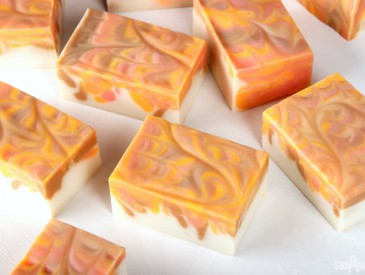
Orange Peel Swirled Soap Tutorial
This orange soap uses several orange colorants and Orange Peel Cybilla for a super bright and cheery soap!
Ingredients
- 18 Bar Birchwood Mold
- Silicone Liner for 18 Bar Birchwood Mold
- 66 oz. Swirl Quick Mix
- 9.1 oz. Sodium Hydroxide Lye
- 21.8 oz. Distilled Water
- 4 oz. Orange Peel Cybilla Fragrance Oil
- Titanium Dioxide Pigment
- Nuclear Orange Pigment
- Racing Stripe Orange Mica
- Tangerine Wow! Colorant
- Sunset Orange Mica
- Black Oxide
- Swirl Tool Kit or Easy Swirl Tool + Comb Swirl Tool
Instructions
COLOR PREP: To ensure that the Titanium Dioxide blends smoothly into the soap batter, we recommend micronizing it before dispersing it in oil. Please note this is an optional tip but it does help with the titanium dioxide clumping in the soap. =) To micronize colorant, simply use a coffee grinder to blend the colorant to break up any clumps of color and prevent streaks of white from showing in the final soap. We like to use a coffee grinder that has a removable, stainless steel mixing area for easy cleaning. Then, disperse 1 teaspoon of the colorant into 1 tablespoon of sunflower or sweet almond oil (or any other liquid oil). Then in separate containers disperse, Racing Stripe Orange Mica, Tangerine Wow! Colorant, Sunset Orange Mica into 1 tablespoon lightweight oil. Then in separate containers, disperse 1/2 teaspoon Black Oxide and 1/2 teaspoon Nuclear Orange Pigment into 1/2 tablespoon lightweight liquid oil. Use a mini mixer to help get rid of any chunks.
FRAGRANCE OIL PREP: Measure 4 ounces of Orange Peel Cybilla Fragrance Oil in a glass, fragrance oil safe container. Set aside.
MOLD & TOOL PREP: Insert the silicone liner into the wood mold. Have the Easy Swirl Tool and Comb Swirl Tool nearby.
- Slowly and carefully add the lye to the water and gently stir until the lye has fully dissolved and the liquid is clear. Set aside to cool.
- Fully melt the Swirl Recipe Quick Mix oils until completely clear. Once the lye water and the oils have cooled to 110-120 F degrees or below (and are ideally within 10 degrees of each other), add the lye water to the oils and stick blend until very thin trace. If you’d like a harder bar of soap that releases faster from the mold, you can add sodium lactate to the cooled lye water. Use 1 teaspoon of sodium lactate per pound of oils in the recipe. For this recipe, you’d add about 3.5 teaspoons sodium lactate.
- Once you’ve reached a very thin trace, split off about 500 mL into four separate containers. You will also have the original mixing bowl, for a total of five containers.
- To each container, add the dispersed colorants in the amounts below. Whisk in each colorant until fully combined.<br>Container A (large container): 1 Tbs. dispersed titanium dioxide<br>Container B: 1 tsp. dispersed Nuclear Orange Pigment<br>Container C: 1.5 tsp. Tangerine Wow! Colorant<br>Container D: 2 tsp. dispersed Racing Stripe Orange Mica<br>Container E: 2 tsp. dispersed Sunset Orange Mica + 1/16 tsp. dispersed Black Oxide
- Whisk in the Orange Peel Cybilla Fragrance Oil proportionately into each container (it’s okay to eyeball it!) until fully mixed in. If your soap is still very thin, you can quickly blend each with the stick blender to ensure the colorants and fragrance oil are mixed in.
- Pour in all the white soap into the mold. Begin pouring each color into the mold, using a zig-zag pattern up and down the length of the mold. Pour quickly, and don’t worry too much if the colors fall into the white soap. Later in the pouring process, it’s important to pour “low and slow,” to ensure the colors sit on top, but for the first couple passes, it’s okay to pour thicker, faster and less precise.
- Continue this process until you’ve used about half of each color.
- Once you’ve poured about half of each orange hue, begin pouring more slowly, with more purpose. The soap should begin to sit on top of the white soap, rather than dropping into the white. Try to pour each layer next to each other, so there are “stripes” of each color. If necessary, whisk each color to ensure the soap stays fluid enough to pour.
- Once you’ve poured all the soap into the mold, it’s time to use the Comb Swirl Tool. Insert the tool into the top of the soap, and drag it down the length of the mold. This will pull all the layers together.
- Then, it’s time to use the Easy Swirl Tool. Starting on one length side, move the Easy Swirl Tool “back and fourth” or “side to side” making S-shaped curves in the soap. Check out the Instagram video below to see the tools in action!<br>NOTE: Generally, the two swirl tools are used in the same direction in the mold. I wanted to try something a little different for this project. I think the swirl turned out beautifully, but as you can see in the photo below, the Easy Swirl Tool did not drag through all the swirls created by the Comb Swirl Tool. It still turned out great!
- Spritz the top of the soap with 99% isopropyl alcohol to help prevent soda ash. Cover and insulate for 24 hours, then allow the soap to stay in the mold for 2-3 days to harden. Carefully remove from the mold, and slice into bars. Allow to cure for 4-6 weeks and enjoy!
Tried this recipe?Let us know how it was!