




In a charming email interview with a Peace Corps volunteer, Jeremy Davis talks to Bramble Berry about the soaping culture in Ghana, West Africa.
Bramble Berry: Jeremy, give us a quick briefing on what you do in the Peace Corps and where you are right now.
Jeremy Davis:I am a Peace Corps Volunteer serving in Ghana, West Africa. Ghana is an English-speaking nation in between C’ote D’Ivoire and Togo in sub-saharan West Africa. It is a very diverse country with some of the friendliest and most hospitable people in the world. As part of training as a Peace Corps Volunteer in Ghana, a Volunteer will enter into the country, and undergo ten weeks of training before they start their two-year assignment. The ten weeks is spent living with a host family in a small community, intended to immerse the volunteer in the culture and to prepare them for their two-year service.Bramble Berry: So, tell us how you’ve learned about soaping?Jeremy Davis: My host mother was a market trader. She and a group of women made local soap to sell at the market. Soap-making is considered an effective means of income generation for women in Ghana, and is thus promoted by small business advisors, local NGOs, and government agencies. My mother, Comfort Mensah, received her training in the late 1990s in how to make soap. She then progressively grew her business to a large size, with many other women working with her, and selling many bags per week at market.
Bramble Berry: Jeremy, give us a quick briefing on what you do in the Peace Corps and where you are right now.
Jeremy Davis:I am a Peace Corps Volunteer serving in Ghana, West Africa. Ghana is an English-speaking nation in between C’ote D’Ivoire and Togo in sub-saharan West Africa. It is a very diverse country with some of the friendliest and most hospitable people in the world. As part of training as a Peace Corps Volunteer in Ghana, a Volunteer will enter into the country, and undergo ten weeks of training before they start their two-year assignment. The ten weeks is spent living with a host family in a small community, intended to immerse the volunteer in the culture and to prepare them for their two-year service.Bramble Berry: So, tell us how you’ve learned about soaping?Jeremy Davis: My host mother was a market trader. She and a group of women made local soap to sell at the market. Soap-making is considered an effective means of income generation for women in Ghana, and is thus promoted by small business advisors, local NGOs, and government agencies. My mother, Comfort Mensah, received her training in the late 1990s in how to make soap. She then progressively grew her business to a large size, with many other women working with her, and selling many bags per week at market.
Bramble Berry: What are the markets like?
Jeremy Davis: My training group was placed in communities around Techiman, a moderately-sized city located near the center of the country from north to south. Techiman has grown famous for its central market, which has thousands of sellers, traders, and buyers engaging in trade. Everything from farm produce, cloth, animals, housewares, and secondhand clothing is sold there. It’s an amazingly hectic place, something we never in the western world come close to experiencing. A flea market is, well, a flea compared to this giant.
Bramble Berry: What kind of soap does she make?
Jeremy Davis: The soap is basic and not very fancy. She makes two types, one called ‘allata semena’, or banku soap. Banku is a favorite food here, basically fermented maize (corn) cooked and smashed into a big white ball. The soap resembles the food, so they call it that. The second is a yellow bar soap, called Key Soap, after the most popular brand of Soap that is industrially manufactured in Ghana.
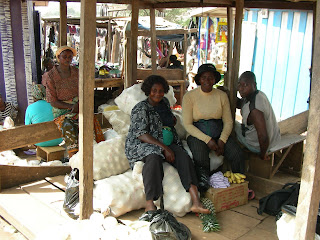 (Jeremy’s house mother selling soap at the central market)
Stayed tuned! More to come from our over seas soaper, Jeremy.
