





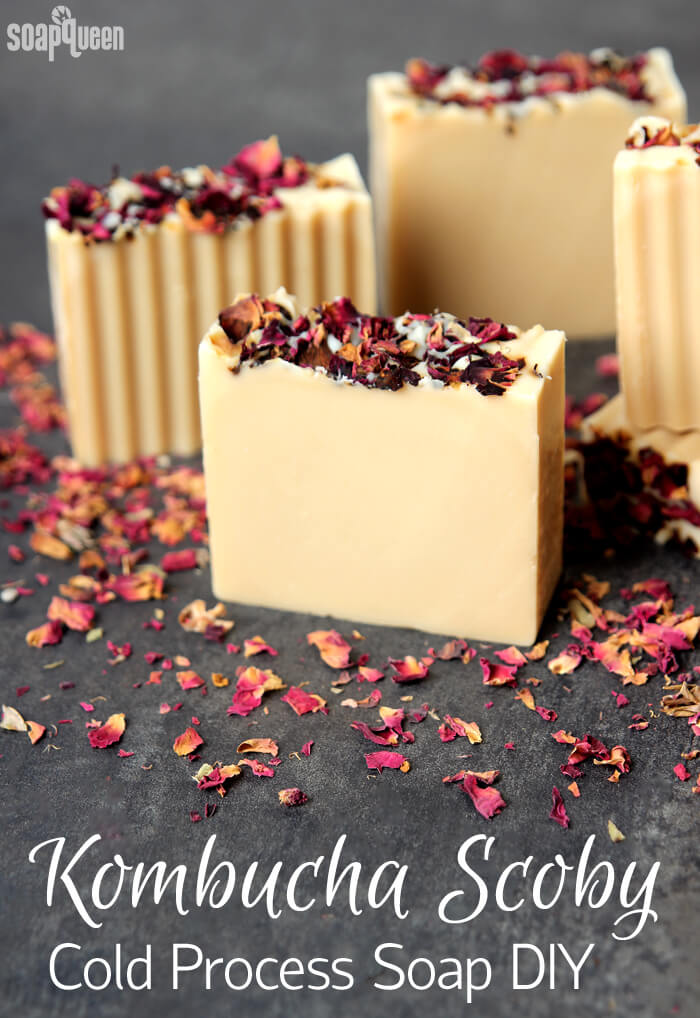
I’m fascinated by how diet and exercise affects our lives, sleep patterns, energy levels and basically, everything. Because of this, I’m always game to try the newest health food craze. Choffy? Sign me up. Bulletproof coffee? Yep. Probiotics? On it. Recently, I have been on a fermented food kick. This includes eating lots of sauerkraut, kimchi and making my own kombucha. If you’re unfamiliar with kombucha, it is fermented and sweetened tea (usually black tea or green tea). It’s a bit of a polarizing beverage as it has a strong vinegar taste. Personally, I love it as do the kiddos. =)
To create kombucha, a “Symbiotic Colony Of Bacteria and Yeast,” also known as a SCOBY, is placed in the tea to ferment the beverage. As the tea ferments, the SCOBY separates and duplicates. The science is pretty amazing! If you’ve ever made kombucha before, you know how quickly your SCOBY duplicates. Soon, you’ll have more kombucha and SCOBY than you know what to do with. After giving away as much SCOBY to friends and family as I could, I thought (as any soapmaker does), “I need to make soap with this!”
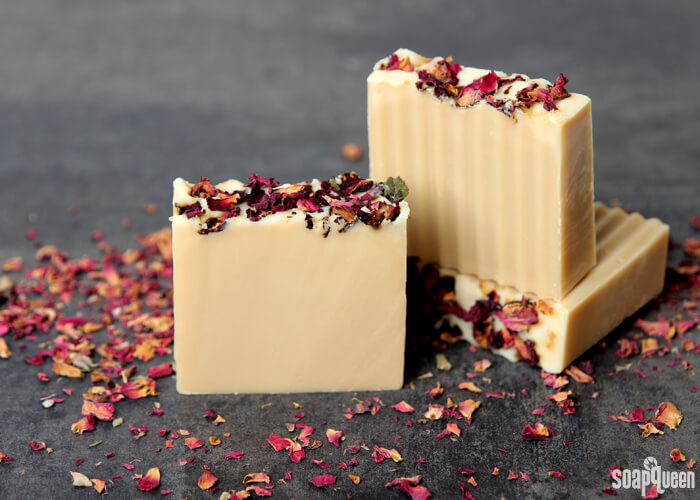
Using kombucha and SCOBY in cold process soap is the same as using other alternative liquids and additives such as purees (click here to learn more about purees in soap). Essentially, the kombucha and SCOBY add sugar to the soap batter, which increases the temperature. I was concerned that replacing 100% of the distilled water in this recipe with kombucha and adding SCOBY would be too much extra sugar. Instead, I chose to puree the SCOBY with a few ounces of kombucha and add the puree at trace.
If you’re curious about how I calculated the water amounts in this recipe with the SCOBY and kombucha, here is how I broke it down:
- The full amount of water in this recipe is 18.15 ounces.
- First, I calculated a 10% water discount to help it unmold faster. This gave me 16.3 ounces of water (18.15 x 0.9= 16.3).
- I’m adding 5 ounces of SCOBY and 3.3 ounces of kombucha at trace. I estimated the SCOBY is about 50% water, which means I’m adding 2.5 ounces of water via the SCOBY.
- The total amount of liquid added at trace is 5.8 ounces; 2.5 ounces of liquid in the SCOBY and 3.3 ounces of kombucha. (3.3 + 2.5 = 5.8).
- To compensate for the added liquid, I subtracted 5.8 ounces from 16.3 ounces to get 10.5 ounces.
To go from 18.15 ounces of water to 10.5 ounces of water looks like a huge water discount. But, keep in mind you are adding 3.3 ounces of kombucha at trace and 5 ounces of SCOBY at trace, which has a large amount of water (approx. 2.5 ounces). Technically, you can safely mix lye and water at a 1:2 ratio. To read more about water discounting your soap, click here.
I did experience some heat-related issues in this batch. You can read about them at the bottom of this post. Keep in mind the sugar and water content in my kombucha might be a little bit different than yours because each brew will be unique. Because kombucha naturally contains vinegar, I was curious how this would affect the pH of my bars. I tested the pH of these bars and it was 8, which is on the lower side of normal for CP soap. This may vary depending on how “strong” your kombucha is. Click here to read more about the pH of cold process soap.
What You’ll Need:
5 Pound Mold with Sliding Bottom
Silicone Liner for 5 lb Wood Mold
8.3 oz. Coconut Oil (15%)
44 oz. Olive Oil (80%)
2.8 oz. Cocoa Butter (5%)
7.4 oz. Sodium Hydroxide Lye
10.5 oz. Distilled Water
3.3 oz. Kombucha Tea
5 oz. Kombucha SCOBY, chopped
3.5 oz. Egyptian Geranium Essential Oil
Rose Petals

Click here to add everything you need for this project to your Bramble Berry shopping cart!
[sq_products]
If you’ve never made Cold Process soap before, stop here! I highly recommend checking out our FREE four part SoapQueen.tv series on Cold Process Soapmaking, especially the episode on lye safety. And if you’d rather do some reading, Bramble Berry carries a wide range of books on the topic, including my newest book, Pure Soapmaking. You can also check out the digital downloads for that instant gratification factor.
SAFETY FIRST: Suit up for safe handling practices! That means goggles, gloves and long sleeves. Make sure kids, pets, and other distractions and tripping hazards are out of the house or don’t have access to your soaping space. Always soap in a well-ventilated area.
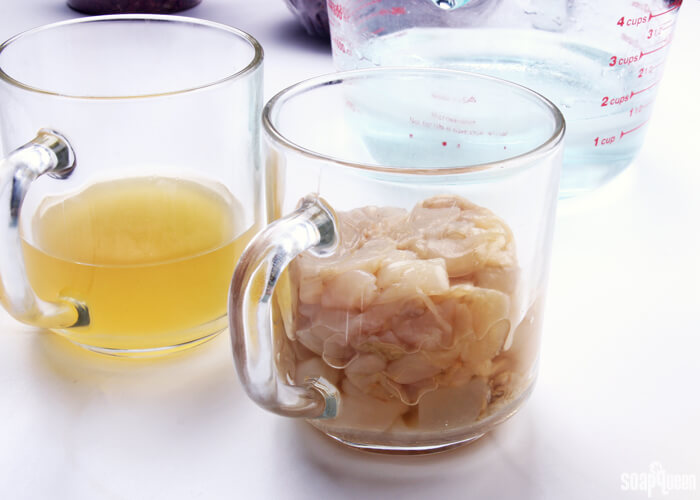
KOMBUCHA + SCOBY PREP: In a small container, measure out 3.3 oz. of kombucha tea. I used room temperature tea. Then, chop up the SCOBY into small pieces and measure 5 oz. Using a blender or food processor (I used a Magic Bullet), blend the SCOBY and kombucha together. You want the mixture to be extremely smooth.
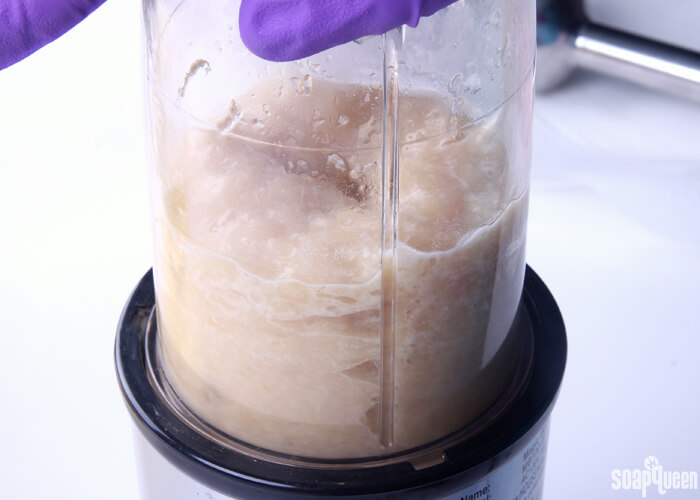
NOTE: Even after plenty of blending, my mixture was not quite as smooth as I wanted it to be. To help blend it further, I added about 2 ounces of my measured and mixed soapmaking oils to help it blend better. If you find the SCOBY blend is not completely smooth, complete steps one and two below. Then, add a small amount of the measured soaping oils to your SCOBY puree and continue to blend. You could also use more kombucha or distilled water if you prefer, just keep in mind you may want to adjust your water amounts if you do so.
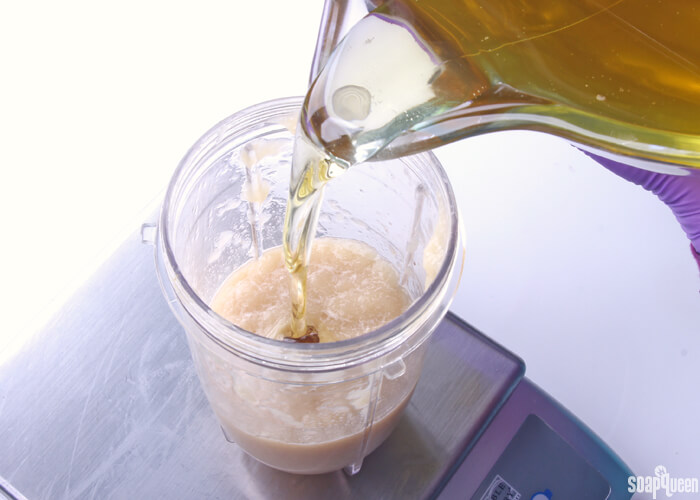
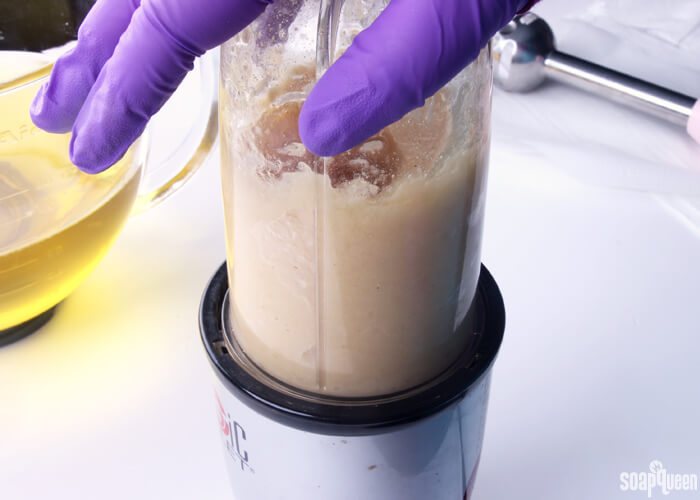
ONE: Slowly and carefully add the lye to the water and gently stir until the lye has fully dissolved and the liquid is clear. Set aside to cool.
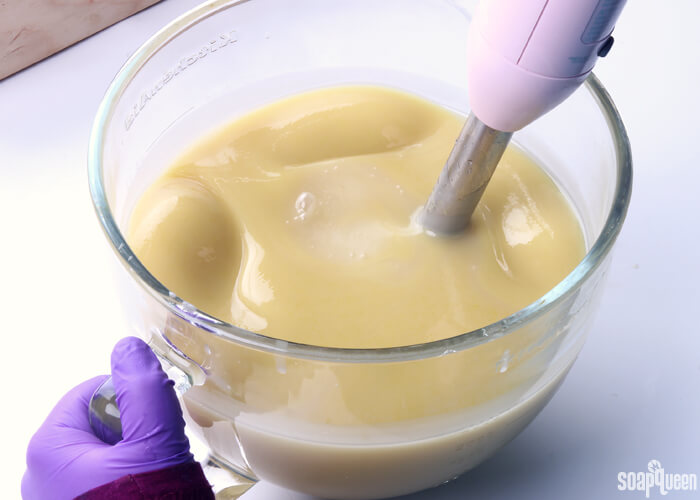
TWO: Melt and combine the coconut oil, cocoa butter and olive oil. Once the lye water and the oils have cooled to 110-120F degrees or below (and are ideally within 10 degrees of each other), add the lye water to the oils and stick blend until thin trace. If you’d like a harder bar of soap that releases faster from the mold, you can add sodium lactate to the cooled lye water. Use 1 teaspoon of sodium lactate per pound of oils in the recipe. For this recipe, you’d add about 3.5 teaspoons sodium lactate. Because this recipe contains a large amount of olive oil, you may find it takes a little bit longer to trace.
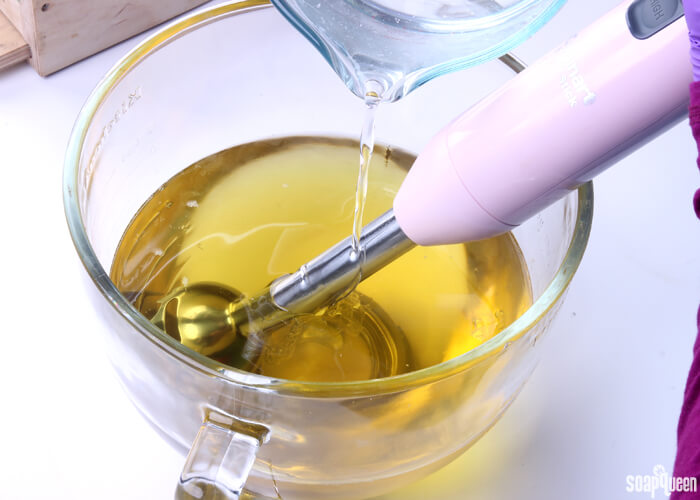
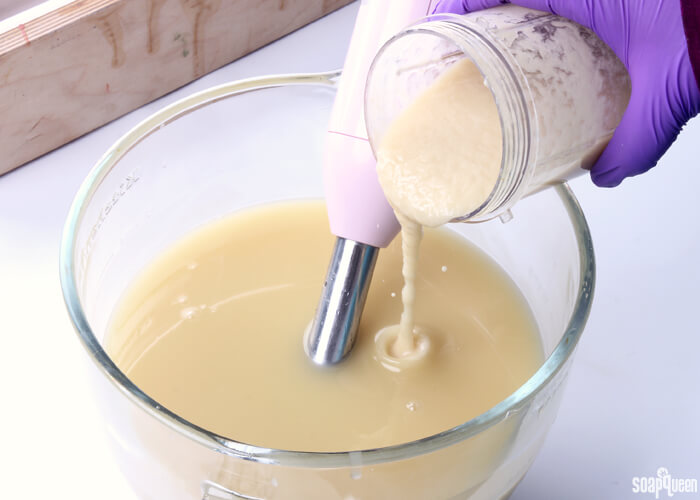
THREE: Once the soap has reached a thin trace, pour the SCOBY mixture into the batter. Use the stick blender to mix in the SCOBY thoroughly.
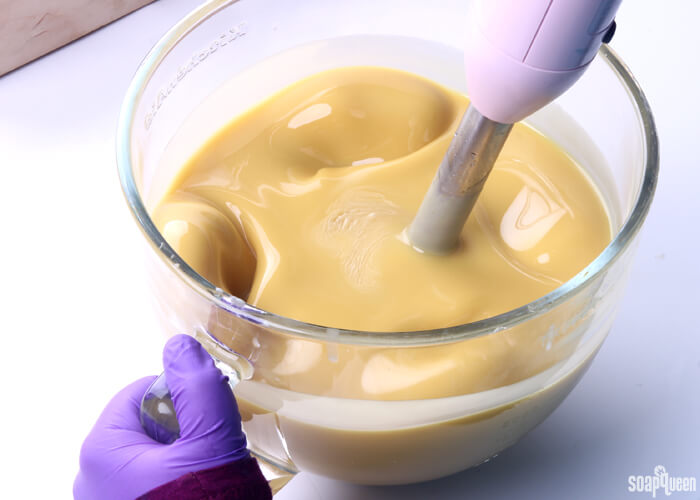
FOUR: Right away, you’ll notice a color change! This happens because of the sugar content in the SCOBY and kombucha scorching as it comes in contact with the lye. Don’t worry, this is normal.
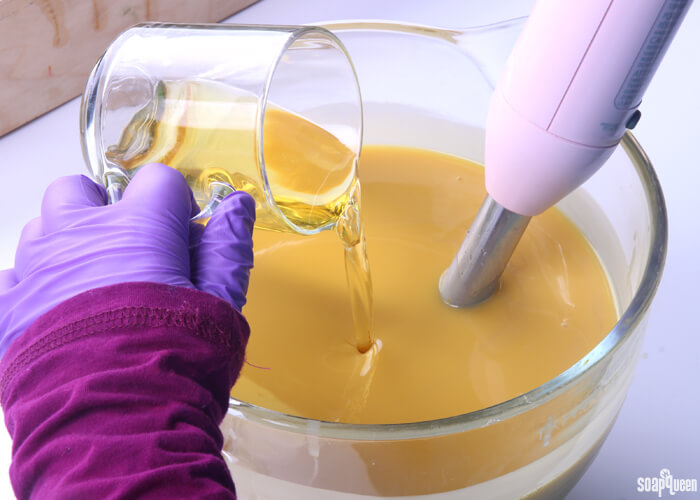
FIVE: Once you add the SCOBY mixture, the batter will start to thicken faster. Once you reach a medium trace, add the Egyptian geranium essential oil. Use the stick blender to thoroughly mix in.
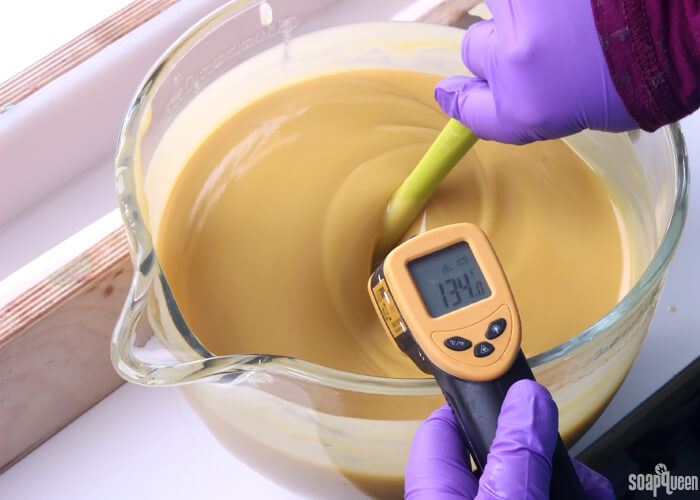
Out of curiosity, I checked the temperature of the soap batter. It was a nice and warm 134 ° F.
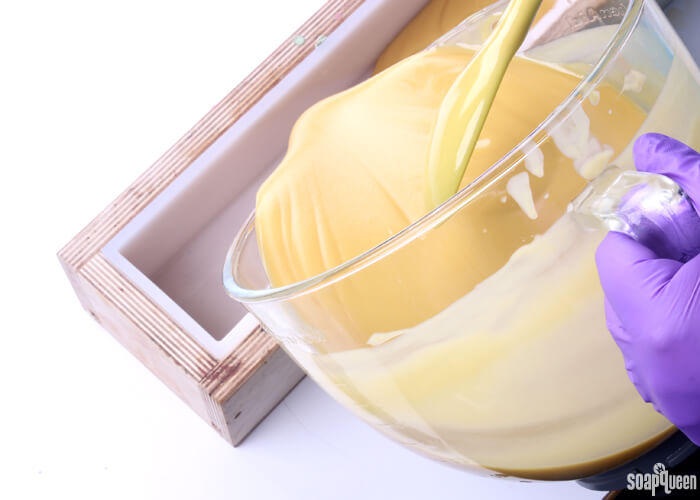
SIX: Pour the soap into the mold. Tap the mold firmly on the counter to help release any air bubbles.
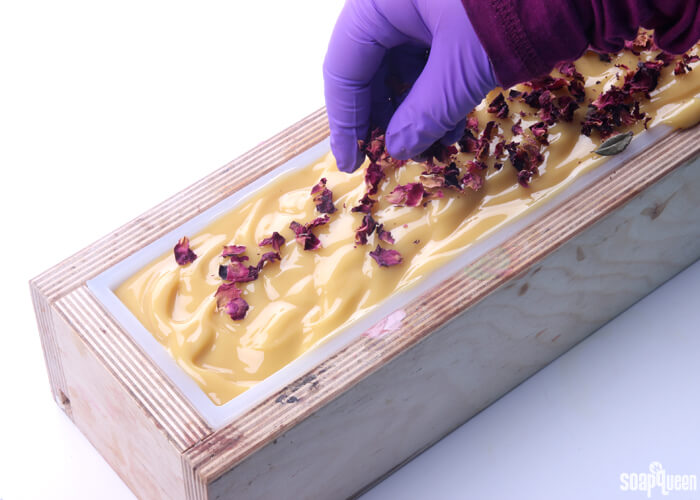
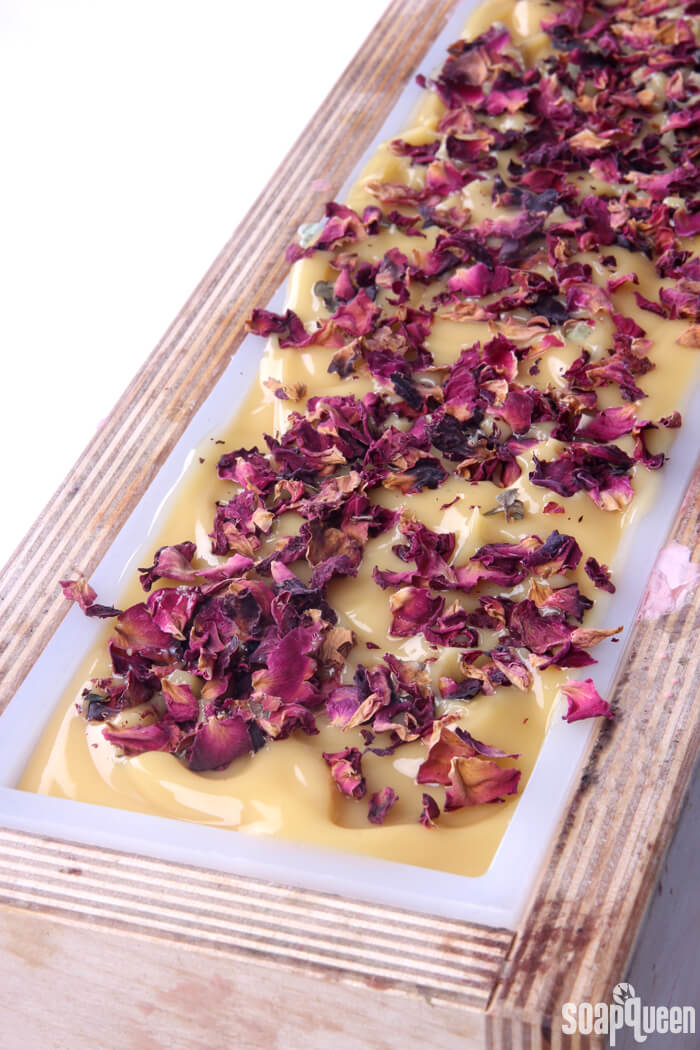
SEVEN: Use a spoon or spatula to spread the soap evenly within the mold. Cover the top with rose petals. To help them stick to the soap, gently press them into the soap with gloved hands. Spray the top with isopropyl alcohol to help reduce soda ash. I did not insulate or refrigerate this soap, but did experience some heat-related issues. Read more about them below. To help prevent them, place the soap in the fridge for 24 hours. Remove from the mold after 3-4 days and cut into bars. Allow the soap to cure for 4-6 weeks before use.
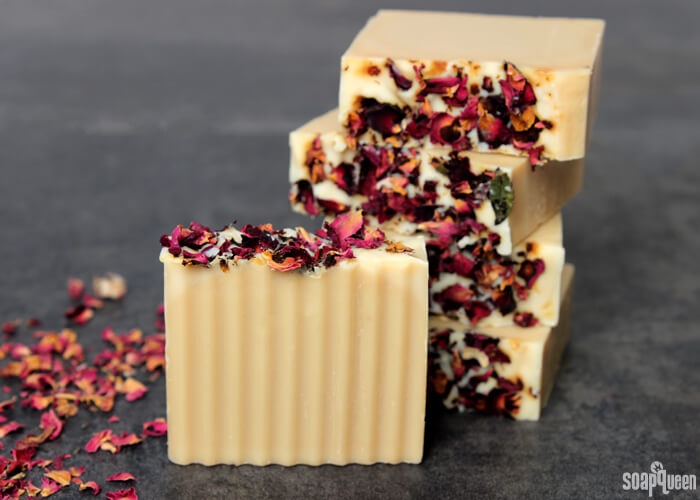
I did not cover, insulate or refrigerate the soap. I wanted to see how it behaved in a normal, room temperature space. I found it behaved relatively well with some minor issues. It did not overheat and volcano out of the mold, but it did show some heat-related problems. When I unmolded the soap, I immediately noticed that the sides had some “pockets” of moisture that looked like separation. I allowed the soap to sit outside of the mold for a few hours, and the moisture completely disappeared. I’m pretty sure the soap boiled in the mold and the moisture was basically condensation. This could be solved by soaping with lower temperatures. You can see what the sides looked like after drying below.
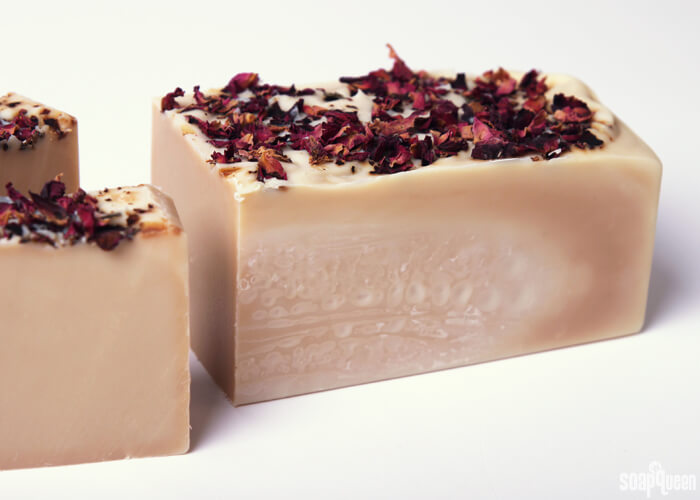 The sides of the soap showed evidence of it becoming quite warm!
When I cut the loaf, I found there was a ring on the inside (see photo below). After cutting, this ring disappeared in about two days and the bars continued to lighten a little bit. Interesting right? I found this ring also occurred in the Buttermilk Bastille Baby Bars. Luckily, both rings faded with time.
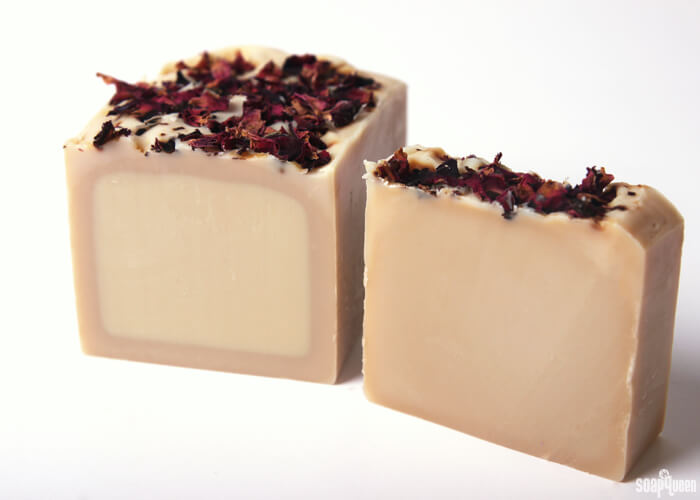 The soap on the left is freshly cut, while the soap on the right has been cut for a few days. Notice the ring on the inside has faded dramatically.
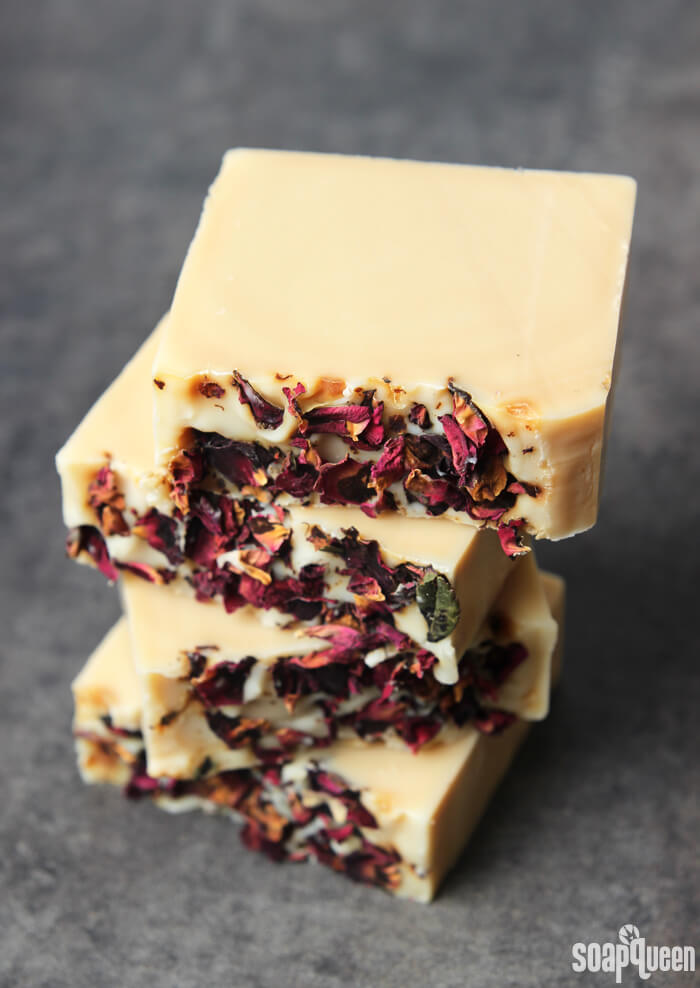
Even with these issues, I think this was a really successful batch. Whatever moisture collected on the sides dried quickly, and the ring faded as well. The sugar from the kombucha and SCOBY boosts the lather. It’s hard to say how much of the kombucha and SCOBY properties remain after the saponification process. But, it’s great from a marketing standpoint. =) Have you ever made soap with kombucha, or SCOBY before? It was a fun experiment!
[expand title=”Click to View the Recipe”]
Kombucha Scoby Cold Process Soap DIY
Ingredients
- 5 Pound Mold with Sliding Bottom
- Silicone Liner for 5 lb Wood Mold
- 8.3 oz. Coconut Oil
- 44 oz. Olive Oil
- 2.8 oz. Cocoa Butter
- 7.4 oz. Sodium Hydroxide Lye
- 10.5 oz. Distilled Water
- 3.3 oz. Kombucha Tea
- 5 oz. Kombucha Scoby chopped
- 3.5 oz. Egyptian Geranium Essential Oil
- Rose Petals
Instructions
SAFETY FIRST: Suit up for safe handling practices! That means goggles, gloves and long sleeves. Make sure kids, pets, and other distractions and tripping hazards are out of the house or don’t have access to your soaping space. Always soap in a well-ventilated area.
KOMBUCHA + SCOBY PREP: In a small container, measure out the 3.3 oz. of kombucha tea. I used room temperature tea. Then, chop up the SCOBY into small pieces and measure 5 oz. Using a blender, or food processor (I used a Magic Bullet), blend the SCOBY and kombucha together. You want the mixture to be extremely smooth. Even after plenty of blending, my mixture was not quite smooth as I wanted it to be. To help blend it further, I added about 2 ounces of my measured and mixed soapmaking oils to help it blend better. You could also use more kombucha if you have it.
- Slowly and carefully add the lye to the water and gently stir until the lye has fully dissolved and the liquid is clear. Set aside to cool.
- Melt and combine the coconut oil, cocoa butter and olive oil. Once the lye water and the oils have cooled to 110-120 degrees or below (and are ideally within 10 degrees of each other), add the lye water to the oils and stick blend until thin trace. If you’d like a harder bar of soap that releases faster from the mold, you can add sodium lactate to the cooled lye water. Use 1 teaspoon of sodium lactate per pound of oils in the recipe. For this recipe, you’d add about 3.5 teaspoons sodium lactate. Because this recipe contains a large amount of olive oil, you may find it takes a little bit longer to trace.
- Once the soap has reached a thin trace, pour the SCOBY mixture into the batter. Use the stick blender to mix in the SCOBY thoroughly.
- Right away, you’ll notice a color change! This is happening because of the sugar content in the scoby and kombucha scorching as it comes in contact with the lye. Don’t worry, this is normal.
- Once you add the SCOBY mixture, the batter will start to thicken faster. Once you reach a medium trace, add the Egyptian geranium essential oil. Use the stick blender to thoroughly mix in.
- Pour the soap into the mold. Tap the mold firmly on the counter to help release any air bubbles.
- Use a spoon or spatula to spread the soap evenly within the mold. Cover the top with rose petals. To help them stick to the soap, gently press them into the soap with gloved hands. Spray the top with isopropyl alcohol to help reduce soda ash. I did not insulate or refrigerate this soap, but did experience some heat related issues. Read more about them below. To help prevent them, place the soap in the fridge for 24 hours. Remove from the mold after 3-4 days and cut into bars. Allow the soap to cure for 4-6 weeks before use.
[/expand]
