




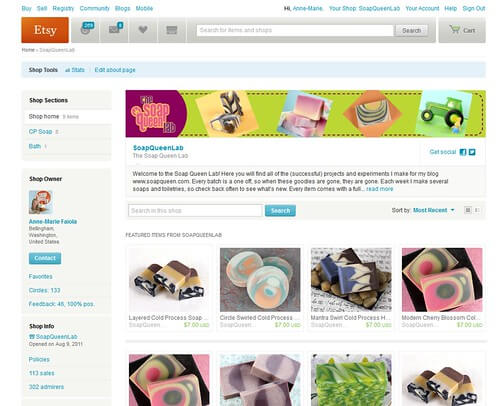
Etsy recently updated their policy on a variety of products that many Soap Queen readers and Bramble Berry customers make: products to help with acne (usually containing Tea Tree Essential Oil), anti-wrinkle creams and serums (often containing luscious ingredients like Tamanu Oil or Seabuckthorn Extract), diaper rash creams (often containing zinc oxide) and anything making anti-itch statements (often with additives like calamine or calendula-infused oils). This move has caused some confusion and frustration in the Etsy marketplace. Bottom line: follow the current, existing FDA guidelines for labeling cosmetics and you will be in compliance with Etsy’s new policy.
For the long post details, including actual languaging from FDA Warning Letters, links to the FDA site, statements from Etsy on the issue, continue reading by clicking “more”.
You can read Etsy’s full and official policy here. At the same time they changed their policy regarding cosmetics making medical claims, they also prohibited actual drugs (like Spice), body parts (teeth and human remains), flammable items and motor vehicles. The FDA has clear definitions on what a soap, a drug and a cosmetic are. You can read those definitions here. Full FDA labeling laws are here. Full FDA Cosmetic Links page is here. I find Marie Gale’s book Soap and Cosmetic Labeling very helpful when trying to make sense of the FDA jargon.
This is a good example of medical claims that are unacceptable taken directly from the FDA site: “Some examples are claims that products will restore hair growth, reduce cellulite, treat varicose veins, increase or decrease the production of melanin (pigment) in the skin, or regenerate cells…. a fragrance marketed for promoting attractiveness is a cosmetic. But a fragrance marketed with certain “aromatherapy” claims, such as assertions that the scent will help the consumer sleep or quit smoking, meets the definition of a drug because of its intended use.” Etsy has taken the policy that if you are making medical claims about any particular item (prevent, treat, or cure a medical condition of any type), you are out of compliance and cannot sell on Etsy. This is in line with current law written by the FDA, so Etsy’s rules aren’t anything new.
There is a difference between scientific evidence and anecdotal evidence. According to the FDA, you cannot make scientific claims without the backing of scientific studies. Anecdotal evidence is not allowed to be used on packaging or in advertising of cosmetics. It is important that we follow existing FDA guidelines both for ourselves and for our customers. Additionally, with the pending legislation that may affect our industry, it helps everyone when current small batch producers follow existing law.
Lauren Engelhardt, representing Etsy had this to say about cosmetic based claims:
“I’ve seen some questions raised about cosmetic products. It’s OK to describe a product as having cosmetic properties or benefits, like saying it is moisturizing, conditioning, softens skin, deodorizes, beautifies, de-tangles hair, etc. Those are not medical drug claims; those cosmetic descriptions do not correlate the product to the cure or treatment of a health condition.
Using language like “this product MAY have an effect to cure or treat a health condition or illness” is still considered a medical drug claim under this policy.
Using a disclaimer is not an acceptable workaround for stating a medical drug claim in your listing. You are welcome to keep any accurate disclaimers or warnings. But all medical drug claims will still need to be removed from the presentation of your item.
The policy prohibits medical drug claims about an item. Etsy is not banning any specific words from being used in a listing; words like “cures” or “helps” on their own do not necessarily indicate a medical drug claim. However, if you are using those words to imply that using the item will cure or help relieve a health condition or illness, then you will need to remove that from your listing. Similarly, avoid using disease or illness terms to imply your product is useful for curing or treating those afflictions. This includes use in title and tags, as well as description.
As long as you exclude any medical drug claims, you can still mention folklore, mythology or historical/cultural significance of item, materials and ingredients in listings.
The policy pertains to all listings on Etsy. A seller may not make claims that using their product (whatever the item may be) correlates with the cure or relief of a health condition or illness. This includes historical, folklore or “time-tested claims that make a correlation between the product and the cure or relief of a health condition or illness.”
Etsy appears to be trying to understand their new policy. It’s clear from the paragraphs above that things are still a little grey in Etsyland. Which is understandable given that labeling cosmetic products is complicated. Another sign that Etsy is still working out the kinks is that one Etsy seller said that they received clarification from the Etsy team that it was okay to mention traditional uses as long as you don’t mention a particular disease. “This herb has long been used to promote calmness.” versus “This herb is a traditional insomnia remedy.” Again, Bramble Berry’s position is that all sellers in any marketplace (your own website, Farmer’s Market, Etsy, Artfire etc…) should always follow the FDA guidelines on making medical claims. More information and clarification on medical claims below, taken directly from FDA warning letters to vendors.
The FDA has cited the following language as medical claims with respect to product ingredients and products marketed as cosmetics. According to public records readily available on the FDA website, the products were considered drugs by the FDA ( and there are many, many more).
Examples of medical claims below taken from a letter to M.W. Laboratories (full text of letter here).
*”a powerful combination of antioxidants and anti-inflammatories that help reduce stress and inflammation of the skin.”
*”Protection Lotion is a unique lotion formulated for inflamed skin conditions such as atopic dermatitis, radiation burns and stretch mark prevention.”
*”Helps reduce inflammation and pain associated arthritis and muscular discomfort”
“A uniquely formulated lotion that helps to reduce inflammation as well as minimize and potentially prevent bruising.”
“Can be used in conjunction with Post-Op to minimize scarring.”
“an incredible scar and keloid reducing formula”
“helps to reduce inflammation and scarring”
“accelerate the skin’s healing processes”
“formulated to help reduce the inflammation and irritation associated with minor skin irritations, insect bites and minor sunburn.”
“Helps reduce stress and inflammation of acne skin.”
“Accelerates healing, regulates sebaceous output, reduces bacterial”
“Soothes inflamed skin and reduces bacteria.”
“Antioxidant, anti-inflammatory and healing agents will help reduce the effects of environmental stresses to the skin”
The listed ingredients of this product include:
Water, Helianthus Annuus (Sunflower) Seed Oil, Cetearyl Alcohol, Ceteareth-20, Triticum Vulgare (Wheat) Germ Extract, Glycerin, Mangifera Indica (Mango) Seed Butter, Butyrospermum Parakii (Shea Butter), …
“…In evaluating the regulatory status of this product, we considered that the labeling does not differentiate between the active and inactive ingredients. Therefore, it is our position that the components listed above as “Ingredients” for J Hansyd Hand and Nail are all active ingredients. Under 21 C.F.R. § 201.66(b)(2) any component in a drug that is intended to furnish pharmacological activity or other direct effect in the diagnosis, cure, mitigation, treatment, or prevention of disease, or to affect the structure or any function of the body of humans, would be considered an active ingredient.” Full letter here.
Of another specific product described as:
“A specially formulated lotion designed to help reduce inflammation and pain associated with arthritic pain and muscular discomfort.”
‘Based on its labeling, including the online brochure, Deep Pain Care Hot is a topical product used to reduce inflammation associated with arthritis and muscular discomfort. As described in more detail below, Deep Pain Care Hot does not conform to the TFM for OTC External Analgesics; it is not eligible for the OTC Drug Review; and it violates various provisions of the Act.’
**The ingredient list for this product:
“Water, Methyl Sulfonyl Methane (MSM), Arctium Majus Root (Burdock) Extract, Zingiber Officinate (Ginger) Root Extract, Piper Nigrum (Pepper) Seed Extract, Capsicum Annuum Extract, Artemisia Absinthium (Wormwood Oil), Arnica Montana Flower Extract, Calendula Officinalis Flower Extract, Eucalyptus Globulus Leaf Oil, Glycerin, Niacinamide, Menthol, Cinnamomum Camphora (Campohor) Bark Oil, Xanthan Gum, Eugenol, Glucosamine Sulfate, Sodium Polyacryloyldimethyl Taurate, Hydrogenated Polydecene, Trideceth-10, Phenoxyethanol, Iodobutylcarbamate.”
… evaluating the regulatory status of this product, we considered that the labeling does not differentiate between the active and inactive ingredients. Therefore, it is our position that the components listed above as “Ingredients” for Deep Pain Care Hot are all active ingredients. Under 21 C.F.R. § 201.66(b)(2) any component in a drug that is intended to furnish pharmacological activity or other direct effect in the diagnosis, cure, mitigation, treatment, or prevention of disease, or to affect the structure or any function of the body of humans, would be considered an active ingredient.
All referenced from this warning letter from the FDA
www.fda.gov/ICECI/EnforcementActions/WarningLetters/2009/ucm212634.htm
********************************
Anther letter sent to a company specializing in Aloe Vera based products:
Examples of some of the product-specific claims observed on your website:
“Apricot Kernel Oil [an ingredient in your product] supplies . . . a natural source of cancer fighting laetryl lipids.”
“Borage Oil equals the GLA content found only in mother’s milk. These unsaturated fats are incorporated into cell membranes to help with electron movement and insulate the body against heat loss. They prevent drying and flaking of skin; the precursors of hormone-like substances that supply collagen and elastin for better skin tone.
“Natural B vitamins in the soy and safflower oils help in cell formation and build skin immune functions.”
“Soy protein [an ingredient in your product] is often documented as a cancer preventative agent
“Apricot kernel oil [an ingredient in the product] is high in gamma-linolenic acid that prevents the breakdown of elastic fibers and collagen that restores firmness to the tissues. These essential elements . . . are a natural source of cancer fighting laetryl lipids.”
“Natural B-vitamins in the safflower and avocado oils [ingredients in this product] help in cell formation and build skin-immune functions. These oils renew skin flexibility by permeating natural vitamins A and E into skin cells, making regeneration of these cells occur faster.”
““Natural B vitamins in the soy and safflower oils [ingredients in this product] help in cell formation and build skin immune functions. These oils renew skin flexibility by permeating vitamins A and E into skin cells, making regeneration of these cells occur faster. For these reasons soy oil is often suggested as a cancer preventative.””
“First Aid in a Bottle”
“[S]tops acne eruptions and irritations . . . .”
“[A]ntiseptic for aftercare, helps with ingrown hair, acne eruptions.”
“[T]reatment for psoriasis and eczema.”
“[A]ids wounds and areas of infection.”
“[H]elp to prevent injuries to the skin tissues and increase the healing rate when these tissues are damaged.”
“Aloe vera [an ingredient in your product] is an antiseptic, fungicide and a bactericide. This natural wound serum speeds relief for burns, cuts, abrasions, and stops itch caused by tissue restoration or bug bites.”
“[U]se Aloe Comfrey Gel generously . . . to heal the affected skin tissue area.”
Chamomile [an ingredient in the product] is an anti-inflammatory and anti-microbial herb. This, along with the aloe, soothes irritation and reduces swelling or puffiness. This product is excellent for use on skin conditions such as eczema and psoriasis . .
“Aloe Stic contains 11% of this [tea tree oil] anti-inflammatory, anti-bacterial substance.”
“The lipophilic nature of tea tree oil enables it to chemically combine with fats and other lipids. The strong solvency of this oil assists in cleaning out and dissolving pustules and cysts. This obviously makes a great acne treatment.”
“Use this Aloe Stic to ease the dry, flaking and cracking skin on psoriasis areas. Comfort comes immediately to dry cracked feet by eliminating the inflammation of corns, calluses and bunions.
Itching from insect bites, poison oak or rashes is stopped for hours after applying Aloe Stic.”
“[S]lows recurring cold sores.”
Full letter here.
******************************
Here is a letter regarding essential oils and claims:
www.fda.gov/ICECI/EnforcementActions/WarningLetters/2006/ucm075968.htm
******************************
I hope this helps to clarify the difference between cosmetic claims and medical claims. By understanding the FDA rules and regulations and complying with them, you will be in compliance with the new Etsy rules and regulations.
