





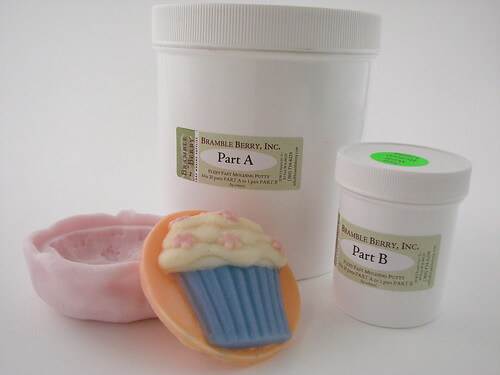
We’re totally jazzed about Flexy Fast, our new versatile silicone that makes it possible for you to make your own molds at home. Want to do a custom product for a special customer? It’s easy with Flexy Fast! Want to do a realistic texture screen? It’s easy with Flexy Fast!
Soap Queen TV will be doing an episode on Flexy Fast in August but until then, here are some tips and instructions on working with Flexy Fast Silicone Molding Putty.
Flexy Fast comes as 2 parts. The usage is 1:6 by weight or 1:20 by volume. Think marble to golf ball. It is a two-component mold making silicone that is applied directly to almost any model. It sticks to itself and can be used with most any base (wax, gypsum, resin, sculptures, etc…)
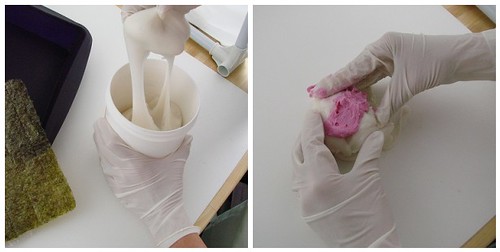
Tip: This product is mixed by hand and wearing gloves is required. We recommend vinyl gloves, as latex gloves tend to stick to the mold putty. The photo below is using latex gloves and it was a mess!
Tip 2: Pre-kneading Part A (working in your hands for one minute prior to mixing with Part B) will make the two components easier to mix.
Step 1: Measure by weight or measure by volume. If doing weight, use an accurate gram scale and weigh out 100 parts A – level by hand into bottom of container. Squeeze 6 parts B into center of flattened Part A. The by volume mix ratio is about 20A:1B (golf ball: marble)
Step 2: Measure an amount of Part A approximately equal to the size of a golf ball onto the palm of your hand and create an indentation. Squeeze an amount of Part B approximately equal to the size of a small marble into the center of the Part A indentation. (Hint: It is better to start out with less Part B and add more if needed, rather than too much Part B).
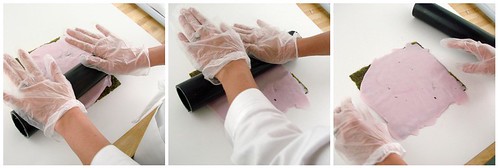
Step 3: Fold the Part A around the Part B and knead aggressively with thumb and forefinger. Continue folding until a uniform light-pink color is attained. Make sure that all color streaks have been eliminated. Getting a thin layer formed is easiest with a rolling pin and the thinner you can make your putty, the less money you have to spend on your mold.
Step 4: Flexy Fast can be applied directly onto almost any model surface (see preparation above) except skin. After mixing Parts A & B as directed above, flatten mixture and gently press into model detail. Spread evenly over model surface, maintaining about a 3/8” (1 cm) thickness. Mix and apply more as needed, connecting and smoothing seams of different batches together. Because no two applications are quite the same, a small test application to determine suitability for your project is recommended if performance of this material is in question. In this case, I did one side as a seaweed kelp sheet and the other side with bubble wrap for a fun texture sheet.
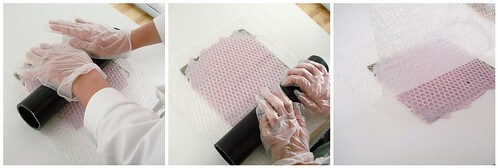
Be Careful: If your original is made of modeling clay or other soft material, pressing putty onto model surface may affect model detail.
Curing: Allow the mold to cure 20 minutes at room temperature (77°F/25°C) before removing from model surface. Adding more Part B can reduce cure time. Adding less Part B will give you a longer working time and lengthen demold time. If applying a support shell, apply the shell before removing the rubber mold from the model.
Using The Mold: When first made, silicone rubber molds exhibit natural release characteristics. Depending on what is being cast into the mold, mold lubricity may be depleted over time and parts will begin to stick. No release agent is necessary when casting wax or gypsum. Applying a release agent prior to casting polyester, polyurethane and epoxy resins is recommended to prevent mold degradation.
Fun Fact: ‘Let’s Get Soapy’ latest special edition eZine covers how to make handmade texture sheets and more uses for molding putty.Check in later this week on what I did with the seaweed sheet mold and learn how to make sushi soap!
