




• July 26, 2015

Lotion Bases
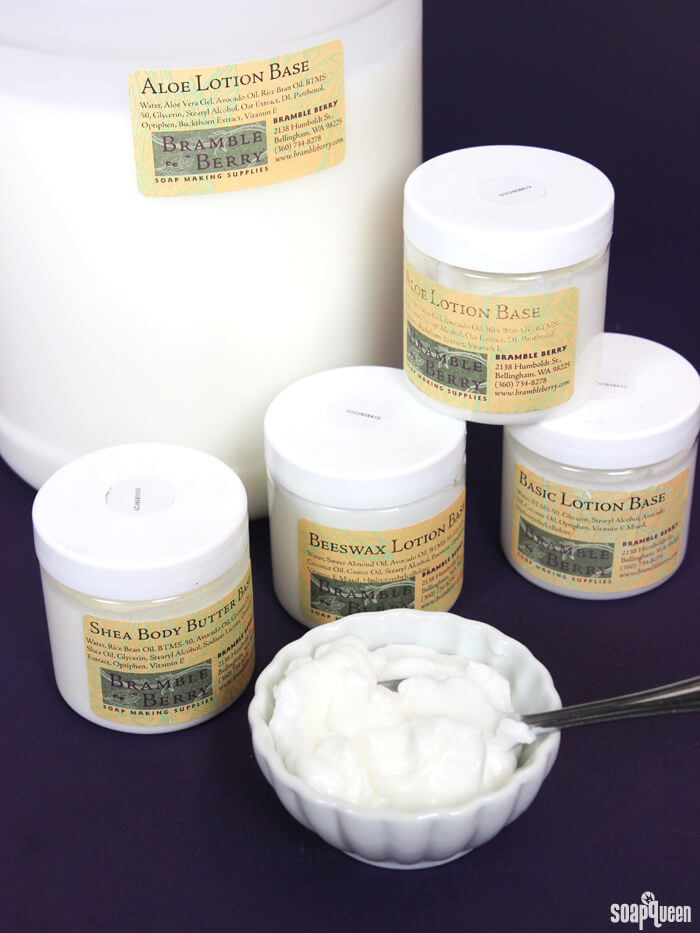
Making lotion from scratch is a fun project. The process includes emulsifying water and oils, much like making soap. Other additives such as extracts, vitamin E and DL-panthenol can also be added to increase benefits to the skin. If you love the feel of homemade lotion but don’t want to formulate it yourself, the Bramble Berry Lotion Bases are here to help! These pre-made bases are ready to customize with scent and color.

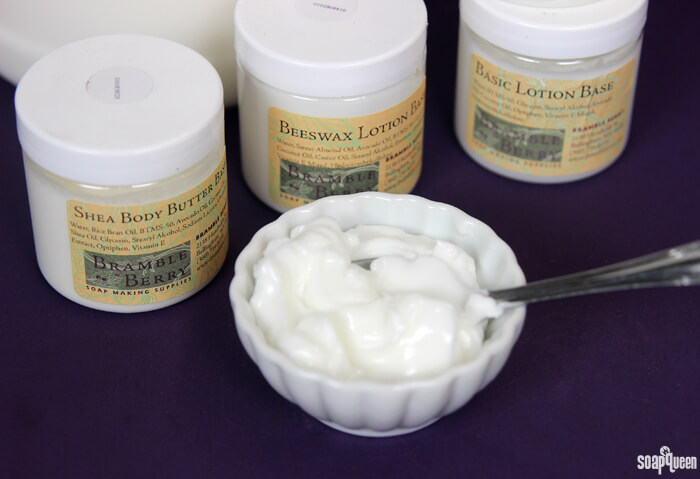
The lotion bases come in four varieties: Aloe Lotion Base, Basic Lotion Base, Beeswax Lotion Base and the Shea Body Butter. The main ingredient for all the bases is water; what makes them different are the types of oil, extracts and other ingredients such as emulsifiers. All the bases include the preservative optiphen to prevent mold and bacterial growth. To learn more about preservatives and how to us them, check out this blog post. Check below to see the ingredients of each base!
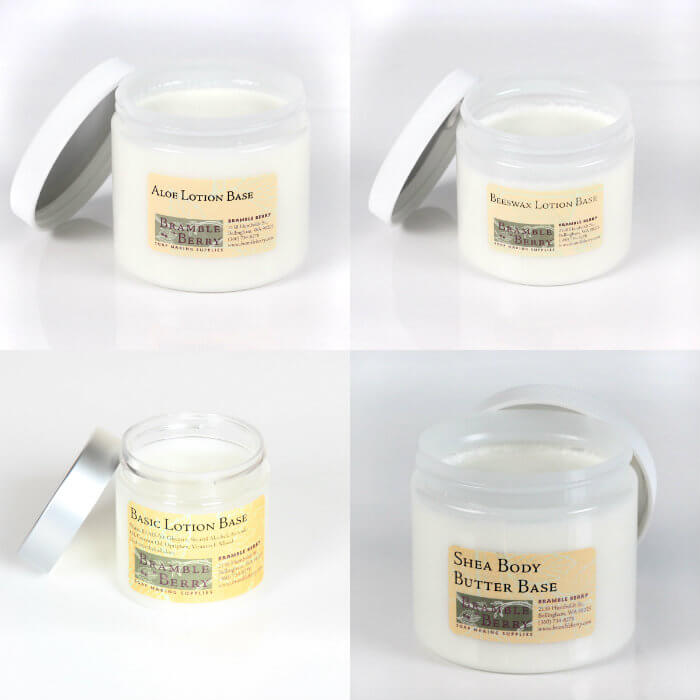
lotioncollage


Lotion Bases Ingredients:

  • Aloe Lotion Base: Water, Aloe Vera Juice, Avocado Oil, Rice Bran Oil, BTMS-50 (Moisturizing thickener), Glycerin, Stearyl Alcohol, Oat Extract, DL Panthenol, Optiphen (Preservative), Buckthorn Extract, Vitamin E
  • Beeswax Lotion Base: Water, Sweet Almond Oil, Avocado Oil, BTMS-50,  Glycerin, Coconut Oil, Castor Oil, Stearyl Alcohol, Beeswax, Optiphen, Vitamin E, Hydroxyethylcellulose
  • Basic Lotion Base: Water, Sweet Almond Oil, Avocado Oil, BTMS-50,  Glycerin, Coconut Oil, Castor Oil, Stearyl Alcohol, Beeswax, Optiphen, Vitamin E, Hydroxyethylcellulose
  • Shea Body Butter: Water, Rice Bran Oil, BTMS-50, Avocado Oil, Coconut Oil, Glycerin, Shea Oil, Stearyl Alcohol, Sodium Lactate, Chammomile Extract, Preservative, Vitamin E Oil

Which base is right for you? First, consider the texture. If you’re looking for a rich thick product, the Shea Body Butter Base or Beeswax Lotion are good options. If you prefer a thinner texture, the Basic Lotion Base or the Aloe Lotion Base have a lighter feel. Keep in mind that the texture may also affect how you package your product; thicker lotions are best in a jar or squeeze bottle, while thinner products can be put into a pump style bottle.

These lotion bases can be used as is, or customized with color and fragrance. To customize, place the lotion base into a disinfected container (5% bleach water or rubbing alcohol will disinfect your mixing containers). Heat the base to about 130 °F, but no hotter than 176 °F. If the base gets too hot, the preservative (optiphen) in the base begins to degrade. Once the base has been heated, the consistency will change to a melted milkshake texture.

Heating the base to create a thinner texture makes fragrance and color easier to mix in…with one exception. The Aloe Lotion Base is the thinnest of all the bases and does not require heating before adding fragrance or color. But, if you prefer to heat the Aloe Lotion Base before customizing, you certainly can! Check out the Burnt Sugar Shimmer Lotion Tutorial for step by step instructions on how to use the Aloe Lotion Base.
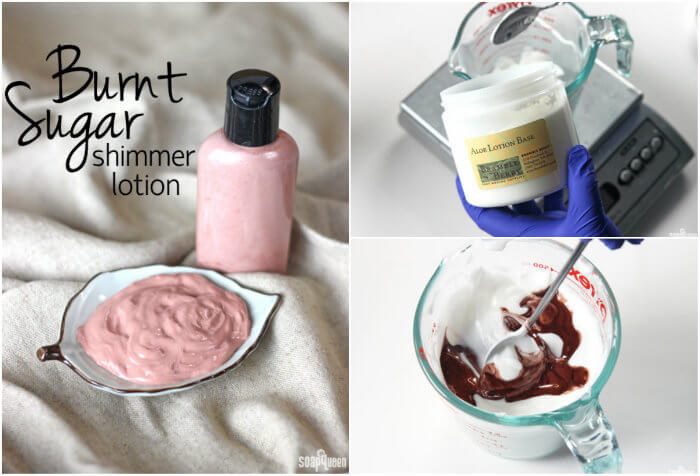
burntsugarcollageThe Aloe Lotion Base is thin enough that it does not need to be heated in order to add fragrance and color. 

Once the base has been heated, add your fragrance or essential oil in the recommended usage rate; find out the correct amount to add with the Fragrance Calculator. Stick blend in the fragrance or essential oil thoroughly and place in your container. A stick blender is the best thing to create a homogenous product. Once the lotion has been stick blended for several minutes, pour the mixture into your container and allow the mixture to fully cool without the cap to allow condensation to escape.

To add color, heat the product as directed above. The best colorant options for lotion are LabColors or micas. Diluted LabColors will not leave any color on the skin when used in small amounts. LabColors go a long way, so just a few drops will give your lotion great color. To add micas to your lotion base, the powder can be added directly or dispersed in a small amount of lightweight liquid oil or fragrance oil to help it blend into the base easier. The particles of oxides and pigments are larger than micas, and do not mix in very well. This could cause your lotion be leave streaks of color on the skin. To learn more about micas, check out the Sunday Night Spotlight: Micas blog post. Curious about LabColors? Check out this post!

All of the lotion bases are formulated to accept up to about 5% of additional oils, extracts, or fragrances by weight, including small amounts of silicones like cyclomethicone. This is because the lotions have an emulsifier surplus, meaning there is more BTMS-50 in the lotion than needed, ready to mix in extra oils. Adding water based products like aloe vera gel or hydrosols do not need additional emulsifier. They will, however, thin your lotion and still need to be stick blended in.

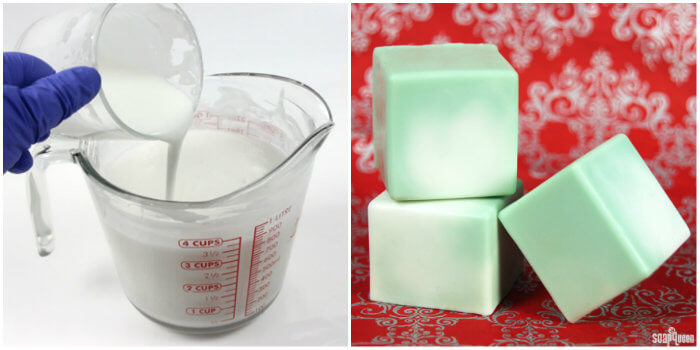
If you’re looking for a fun way to incorporate lotion bases into other products, the Lotion Melt and Pour Cubes are easy to make and skin-loving. Aloe Lotion Base is heated and added directly to melted melt and pour soap. The soap is customized further with LabColors and fragrance oil, then swirled together into cubes. Adding lotion base to melt and pour does cut down on the lather, but adds extra moisture.
mpcollage

Making lotion is fun, but if you prefer working with a tried and true recipe, the Lotion Bases are great. To learn more about lotion making, including frequently asked lotion questions, check out the Talk it Out Tuesday: Lotion blog post. Have you tried working with the Bramble Berry Lotion Bases? I would love to hear your thoughts!
Lotion Bases Spotlight

You may also like these

Become an email subscriber

Enter your email address below and you will receive all our new posts directly in your email inbox.

  1. Hi,
    I’m looking to make a body butter using the basic lotion base as I already have Shea and other butters as additives. How do I go about doing this, including adding color and fragrance? Thank you for your help!

    1. Hi Deborah! Here’s how to use the Basic Lotion Base: Warm the lotion base to 130°F in a fully disinfected container (5% bleach water or rubbing alcohol will disinfect your mixing containers). The lotion base will become the consistency of a melted milkshake. Add your fragrance or up to 5% additional additives (extracts, oils) at the recommended usage rate (typically .1 ounces of fragrance per 16 ounces of lotion) and stir until fully incorporated. Pour carefully into your containers. Let the lotion sit until it is room temperature prior to putting the cap on. The preservative system in this lotion starts to degrade at 176°F. Please ensure your lotion gets no warmer than 130°F during the heating phase. 🙂

      -Kelsey with Bramble Berry

    1. You can use a microwave or a double boiler! Either one works well. 🙂

      -Kelsey with Bramble Berry

  2. Is it ok to use Shea butter and coconut oil in your base?
    Any info would be appreciated.
    Thanks Arlene

    1. Hi Arlene!

      Our bases do allow up to 5% extra oil and butter in them, so you can add shea butter and coconut oil if you like! To do so, we recommend heating the extra oil and lotion base to around 130F (no hotter or the preservative can degrade). Then, stick blend the extra oil into the lotion for several minutes, pour into bottles and allow to cool. 🙂

      -Kelsey with Bramble Berry

      Coconut oil: https://www.brambleberry.com/Coconut-Oil-P3196.aspx

      Shea butter: https://www.brambleberry.com/Shea-Butter-P3220.aspx

  3. Hi! I would like to add tapioca powder to both the Shea and beeswax bases. What amount do you suggest per 8 oz of base? The 5% additive allowance is just for oils, right, not a powder like tapioca? And I’m assuming it’s fine to add after base is heated. Thanks!

    Emily

    1. I thought of another question.

      I’ve been having a hard time covering the smell of Shea butter with the Shea base, depending on the scent. Can I add up to the allowed 5% additive even though that’s more than the recommended amount of fragrance? What happens if you go over 5%? I like the base and want to stick with it but also want my fragrances to work. I’m not planning on adding anything else except the tapioca if you suggest that it would work. Thanks!

      Emily

      1. Hi Emily!

        You can add tapioca powder if you like! I would recommend adding about 1/2 tsp.-1 tsp. per 8 ounces of lotion base. To help it mix in nicely, you can mix it with about 1 tsp. of distilled water. Then, add that to the base. Make sure to stir really well to get that tapioca powder mixed in. If you like, you can heat the base slightly (no hotter than 130F) and stick blend the powder in for several minutes. 🙂

        Tapioca powder: https://www.brambleberry.com/Tapioca-Powder-P3803.aspx

        While you can add up to 5% additives, we recommend sticking to the suggested fragrance and essential oil usage rates. If more is added, it can cause skin irritation. It can also scent your skin quite strongly. The Fragrance Calculator rates are what we suggest: https://www.brambleberry.com/Pages/Fragrance-Calculator.aspx

        To cover up the shea smell, you can add a stronger fragrance! Peppermint Essential Oil is very strong, and a little goes a long way. I would recommend adding just 1 drop to 8 ounces of base. That should help cover some of the shea butter smell. 🙂

        Peppermint Essential Oil, 1st Distill: https://www.brambleberry.com/Peppermint-Essential-Oil-1st-Distill-P3828.aspx

        2nd Distill: https://www.brambleberry.com/Peppermint-Essential-Oil-2nd-Distill-P3832.aspx

        -Kelsey with Bramble Berry

    1. Hi Ambrosia!

      We haven’t tried added those ingredients to our lotion base, so I’m not entirely sure!

      You can add up to 5% of additional oils, extracts or fragrances to our lotion bases. To add those in, we recommend heating the lotion to 110-130F (don’t go over or the preservative can degrade). Then, mix the extras in. You can also stick blend the mixture to ensure everything emulsifies.

      I would recommend adding a bit of the jelly, honey or extract to a small portion of the lotion. That way you can see if they mix in with the lotion before adding anything to the rest of the base. 🙂

      -Kelsey with Bramble Berry

  4. Without knowing the exact formulation of a supplier’s lotion base, how is one to know where any additional ingredients they want to add are to be listed in the ingredient deck for proper labeling? I’ve asked this question to two other suppliers and haven’t received an honest answer. Only one answered, “Well, if it’s under 1% of the formulation, just list it at the bottom. It doesn’t matter what order they’re in.” I already knew about listing ingredients of less than 1%; indeed the order of such ingredients doesn’t matter. When I pressed further, I got no reply. That’s not an honest answer, since what if it’s not under 1%? Why buy such a base? How can we adhere to the GMP if we don’t know this? Must we sacrifice this little legality to the god of “proprietary information”?

    1. Hi Patricia!

      We’d be more than happy to give you the percentages used in the lotion bases! That should help with the labeling process. You can email our customer service team at [email protected] for those percentages. 🙂

      -Kelsey with Bramble Berry

  5. How many small jars will a container of shea body butter base fill? What should I add to the base? Aloe vara juice or a type of oil? Or just add fragrance and mica? Thanks!

    1. Hi Donna!

      How many bottles you fill will depend on the size of your bottles! For instance, the 16 oz Shea Body Butter will fill four 4 ounce bottles or two 8 ounce bottles. If you have smaller jars than that, the base will fill more. 🙂

      Shea Body Butter: https://www.brambleberry.com/Shea-Body-Butter-P5886.aspx

      You can definitely add fragrance and mica to these bases! To find out how much scent to add, you can use our Fragrance Calculator: https://soapqueen.com/bath-and-body-tutorials/tips-and-tricks/use-fragrance-calculator/

      Micas are great to add to lotion, as they are very lightweight and mix in well. If you want shimmer and slight color on the skin, you can start with 1 teaspoon of mica per pound of lotion, and add more if you like! If you want the lotion to have a color but not transfer to your skin, I would recommend about 1/2 teaspoon or less of mica per pound of lotion. 🙂

      We added mica to this Burnt Sugar Shimmer Lotion with great results: https://soapqueen.com/bath-and-body-tutorials/lotion/burnt-sugar-shimmer-lotion/

      As for other ingredients, all of our lotion bases are formulated to accept up to about 5% of additional oils, extracts, or fragrances by weight, including small amounts of silicones like cyclomethicone. This is because our lotions have an emulsifier surplus, meaning there is more BTMS-50 in the lotion than needed, ready to mix in extra oils.

      The easiest way to add oils is to bring a measured amount of your lotion base up to about 110-130°F until it begins to liquefy. Add the calculated amount of your desired liquid and stick blend until smooth. Finally pour into bottles and let sit, uncapped, for 24 hours. 🙂

      If you are having trouble mixing in additives, there are two options: bring the lotion up to its max temperature of 130°F, then add your oils. Then, continue stick blending until lotion begins to re-solidify/thicken, and then pour. Second, you can add a small amount of Polysorbate 20 or 80 to your additive to help it emulsify in.

      Do not exceed 130°F or you risk destroying your preservative! Read more in the Talk It Out Tuesday: Preservatives post: https://soapqueen.com/bath-and-body-tutorials/lotion/talk-it-out-tuesday-preservatives/

      -Kelsey with Bramble Berry

      Polysorbate 20: https://www.brambleberry.com/Polysorbate-20-P3212.aspx

      Polysorbate 80: https://www.brambleberry.com/Polysorbate-80-P4438.aspx

  6. These look really nice and easy! But I have a question. Is otiphen a natural product or is it man made?

Comments are closed.

{"email":"Email address invalid","url":"Website address invalid","required":"Required field missing"}

The Latest from Soap Queen TV

Inspired by Gems & Crystals

All About Essential Oils

The Power of Charcoal

Create Your Own Clay Face Mask

DIY Bath Bombs

Cold Process Soap Tips & Tricks

Learn the Basics of Cold Process Soapmaking

Learn the Basics of Melt & Pour Soapmaking

Want to Start Your Own Soap Business?

Soap Business Success Stories

Soap Queen TV Favorites

Ingredient Spotlight

Disclosure

Unless stated otherwise, all images are original material and are copyrighted. If you'd like to use an image, please be a friend and credit the photo and link back to Soap Queen. Feel free to share, tweet and pin to your hearts content.