





• October 6, 2009
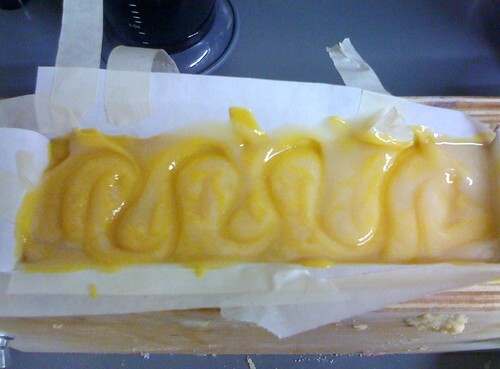
From this: to this:
I made a new Coconut Milk Batch today and switched out two variables:

1. Temperature

2. Fragrance

As cold process soapers know, fragrance makes a huge difference in how your soap performs. At Bramble Berry, we test each and every fragrance three times before adding it to our line. At least one of these tests is a larger batch. Sometimes, what happens in a small batch isn’t how a fragrance reacts in a large batch. The Orange Blossom I tested in the Coconut Milk Soap Volcano had performed admirably in one large batch already and done well in a small batch as well. But, when I tossed in the added stressors of a hot milk batch, well … that was enough to throw the Coconut Milk Soap over the edge.

This batch, I paid attention to the temperatures. When I mixed, my soap was a warm 137 degrees which was still too hot for my liking. The big change was the fragrance switch. I made this soap with Buttercream & Snickerdoodle (2 parts) mixed with Relaxing (1 part). I did 100% Coconut Milk in place of the water and reacted the lye with the Coconut Milk.

The soap did great. It traced quickly and had a wonderful texture once the stick blender had worked its magic. I fragranced the majority of the soap, leaving a bit out for a white swirl to provide texture and contrast to the soon-to-be-brown soap (thanks to the Vanilla in the two fragrances I chose).

I split the batch three ways: 1 log mold, 1 Pumpkin Mold (to test release with this hard CP soap) and 1 Flexy Fast mold.

The non-fragranced soap stayed a cool 103 degrees in the mold.The fragranced pumpkin soap got nice and warm, up to 159 degrees while starting gel phase.The loaf mold stayed a similar temperature at 153 degrees. It did start to expand with all of the heat produced during gel phase and cracked the top of the soap.The soap in the loaf did not get as warm as the 100% fragranced individual soap because the loaf soap had swirls of cooler, non-fragranced soap running throughout. The crack started small, when the soap was around 140.
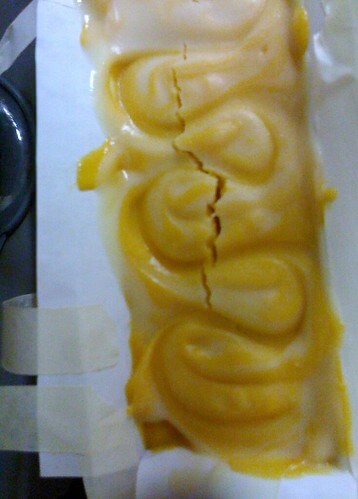

After the soap hit over 150 degrees, the crack started widening and pushing outwards and up. It never got taller or wider than this. Heated soap expands. Since the top layer of soap was cool and more hard than the gelling middle, it gave way to the expanding soap by cracking.

I’ll take photos of the final soap in the next week to share with you. I feel confident that if I lowered my temperatures to 120 and used frozen coconut milk that the soap wouldn’t have cracked. Cracked or not, the soap is one luxurious bar with 75% Coconut, 25% Cocoa Butter and Coconut Milk in place of water. I can hardly wait for the 6 week cure time to use it!


You may also like these

Become an email subscriber

Enter your email address below and you will receive all our new posts directly in your email inbox.

  1. Oh okay, thanks! 🙂 I’ll remember to pour at 120*-130*F next time…I thought that I was pouring to hot but my lye water was cooling down faster than the oils. I was using the same ingredients from a recipe on a dvd I have. I just used different amounts, more of 1 less than another, & adjusted to fit my mold. I then used the BB lye calculator. I used no colorants & fragrances.

    My soap seems to be doing fine, it’s curing nicely. Each slice has a neat top from the bubble-up/cracking & some soda-ash. I’ll find a substitue for the veggetable shortening. What do you reccomend?

    Thank you again! ~Nickie~

    1. Hi Nickie! You can use any oil that you really want to in your soap, but I’d suggest trying out Palm Oil or Avocado Oil in your soaps!

      Avocado Oil: https://www.brambleberry.com/Avocado-Oil-P3198.aspx

      Palm Oil: https://www.brambleberry.com/Palm-Oil-P3210.aspx

      But, be sure to run your recipe through the lye calculator again so you can get the proper amounts!

      Lye Calculator: https://www.brambleberry.com/Pages/Lye-Calculator.aspx

      And, with the soda-ash, the best way to prevent that is to spray the top of your soap (once you’ve poured it into the mold) with a 91% rubbing alcohol solution and then covering the top with cardboard.

      I hope this helps! 🙂
      -Becky with Bramble Berry

  2. I made my 1st CP batch last night! 😀
    My soap (abt 3.5lb loaf) looks like it may have cracked or it just dipped a little. Down the middle of my soap there’s a little dip(?) & some plops, like I let it sit a bit & then took something to make a little crack/dip & plopped soap on the top of the loaf. Then there’s this spot where my soap started to go through gel-phase(?) & bubbled-up because there’s this splatter from my soap up to the plastic-wrap in a wave shape.
    My recipe: 20oz coconut oil (76*), 8.5oz olive oil, 15oz vegetable shortening, 6.4oz lye, 14.36oz distilled water (5% superfat). Poured oils @ 165* & lye/water @ 150*. Could it be my recipe that made it do this or did I mix them too warm?

    Thanks! ~Nckie~

    1. Hi Nickie!

      To prevent your soap from cracking, I’d suggest lowering your temps to around 120-130F. That should help prevent any of the bubbling and cracking that you experienced in your first batch.

      With your recipe, we tend not to use vegetable shortening unless it’s a single-oil blend that has a definitive SAP value since blends that often go into vegetable shortening don’t easily have a definable SAP value.

      I hope that helps!
      -Becky with Bramble Berry

  3. I made a coconut milk soap today as well and it cracked down the center just like yours! I didn’t add any fragrance. I couldn’t believe how hot it got, even after using super cold-stright from the freezer coconut milk AND an ice bath. I clocked it at nearly 200F! However the split fixed itself and all is well. Silly coconut milk soap!

  4. Hi Anne Marie,

    Is there an update on this soap project? How did it cut, did you fill the gap with something else.

    I'm late reading this and perhaps I've missed the update on this project.

    Thanks so much for sharing your projects with us! Cusious minds!

    Pamela

  5. I'm so glad someone asked about the thermometer because I want one!

    I appreciate your doing all that analysis and sharing it with us; it's like a wonderful science experiment that I don't have to clean up. =)

  6. you know how when you make pumpkin or banana bread, that it cracks down the middle!

    or those lovely imported silks that say "the seeming flaws in this fabric are characteristic of this fabric and in no way indicate a defect in workmanship or materials.

    i just thought of this when looking at your lovely soap.

    You could pour something into the crack too! lol!

    i still want a bar…..it looks so incredibly yummy. it truly feeds a passion for all things coconut and cocoa! would you consider selling lol?

  7. Anon, Yes, that would be much less volatile because it's less milk solids and milk proteins. You'd also get less heat and less reaction if you did a 50% water and 50% Coconut Milk to start with.

    The 100% milk just can cause more consternation. But the bars are so luxurious and creamy that it's hard to care. =)

  8. You should be able to get the cracking gone with just changing your temperatures some or doing less insulation. I'd drop your temperatures 10 degrees and start from there.

  9. This is very interesting. Especially since I've read coconut milk will not overheat or react like cow or goat milk since it's not true milk. When I make soap with coconut milk I discount the water I mix with the lye and make up the difference with coconut milk when I combine the lye water and oils. Think I'll keep doing it this way since I've never experienced the volcano or overheating…yet, lol! Thank you for sharing all your research! It's very helpful.

  10. I sometimes get cracks in my soap, but never quite that wide or deep. Perhaps my place is too cool and my soap is too hot. And the remedy for cracking would be……? cover it? allow to cool before the pour (not always possible)….

    ?

  11. Thanks for posting this, very informative. I didn't know you guys tested out your fragrances so much, good to know!

  12. Thank you for the report on this. I never see any of the other vendors doing this kind of stuff and appreciate that you have a true love of the chemistry of soap and all things soap related. Thank you thank you thank you for having a camera at the ready to help us all.

  13. I always appreciate your trials and errors as they allow me to learn what works, what doesn't and what I want to experiment with!

Comments are closed.

{"email":"Email address invalid","url":"Website address invalid","required":"Required field missing"}

The Latest from Soap Queen TV

Inspired by Gems & Crystals

All About Essential Oils

The Power of Charcoal

Create Your Own Clay Face Mask

DIY Bath Bombs

Cold Process Soap Tips & Tricks

Learn the Basics of Cold Process Soapmaking

Learn the Basics of Melt & Pour Soapmaking

Want to Start Your Own Soap Business?

Soap Business Success Stories

Soap Queen TV Favorites

Ingredient Spotlight

Disclosure

Unless stated otherwise, all images are original material and are copyrighted. If you'd like to use an image, please be a friend and credit the photo and link back to Soap Queen. Feel free to share, tweet and pin to your hearts content.