





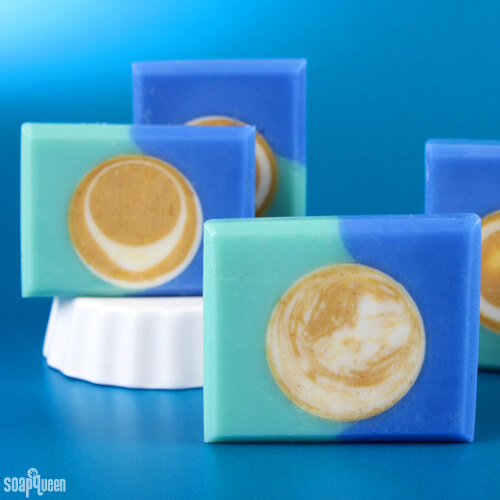
Trying new soap techniques keeps the craft interesting, fresh and fun! This Misty Maritime Moon soap was created for the Negative Space Embed Challenge via Great Cakes Soapworks in August. The negative space embed technique involves cutting holes into the base of soap and later filling the holes with fresh soap.
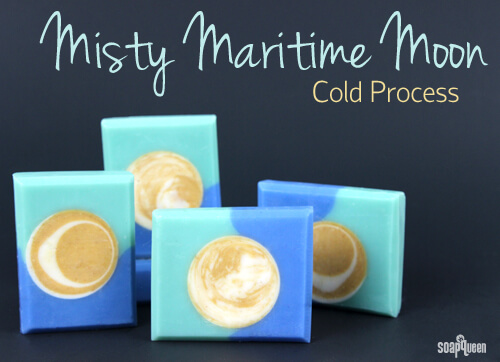
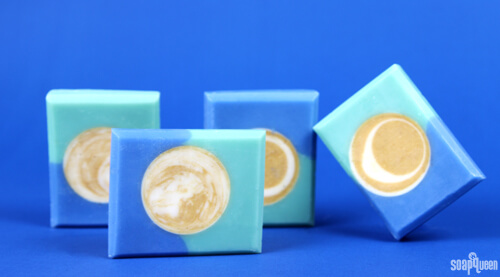
Created with a fresh combination of Pineapple Cilantro, Orange Peel Cybilla and Ocean Rain Fragrance Oils, this soap smells crisp and bright. Orange Peel is used to give both color and texture to the embeds, while titanium dioxide provides contrast. The dual blue tones are made using the Multi-Pour Sectioning Tool, but cardboard can also be used as shown in the Mantra Swirl tutorial. Thanks for all the great name suggestions for this soap via Facebook, they were so much fun to read!
This technique is so exciting because of all the possibilities of shapes you can create. You aren’t limited by the embedding molds you own. Taking a walk through the hardware store opens up all kinds of new possibilities. Having more control over the design is another benefit. Six color rainbow faux-funnel pour coming up next!
What You’ll Need:
Base of the Soap:
15.3 oz. Coconut Oil
15.3 oz. Palm Oil
17.9 oz. Olive Oil
2.5 oz. Avocado Oil
7.2 oz. Sodium Hydroxide
16.8 oz. Distilled Water
2.5 oz Ocean Rain Fragrance Oil
1 oz. Pineapple Cilantro Fragrance Oil
Aqua Pearl Mica
Ultramarine Blue Pigment
5 Pound Mold with Sliding Bottom
Multi-Pour Sectioning Tool
Circular Pipes (PVC Pipes)
Negative Embeds:
5.4 oz. Coconut Oil
6.3 oz. Olive Oil
5.4 oz. Palm Oil
.9 oz. Avocado Oil
2.6 oz. Sodium Hydroxide
5.9 oz. Distilled Water
Orange Peel, Powder
Yellow Oxide
Titanium Dioxide
1 oz. Orange Peel Cybilla Fragrance Oil

 If you’ve never made Cold Process soap before, stop here! I highly recommend checking out our FREE four part SoapQueen.tv series on Cold Process Soapmaking, especially the episode on lye safety. And if you’d rather do some reading, Bramble Berry carries a wide range of books on the topic, including my newest book, Soap Crafting. You can also checkout the digital downloads for that instant gratification factor.
SAFETY FIRST: Suit up for safe handling practices! That means goggles, gloves and long sleeves. Make sure kids, pets, and other distractions and tripping hazards are out of the house or don’t have access to your soaping space. Always soap in a well-ventilated area.
COLOR PREP: Disperse 2 teaspoons of the Aqua Pearl Mica into 2 tablespoons of Sunflower or Sweet Almond Oil (or any other liquid oil). Disperse 1 teaspoon Ultramarine Blue Oxide into 1 tablespoon of light liquid oil. Use a mini mixer to get the clumps of color worked out smoothly.
FRAGRANCE BLEND: In a glass container, combine 2.5 oz. of Ocean Rain Fragrance Oil and 1 oz. of Pineapple Cilantro Fragrance Oil. Set aside.
ONE: Slowly and carefully add the lye to the water and gently stir until the lye has fully dissolved and the liquid is clear. Set aside to cool.
TWO: Combine the coconut oil, olive oil, avocado and palm oils (remember to fully melt then mix your entire container of palm oil before portioning). Once the lye water and the oils have cooled to 130 degrees or below (and are ideally within 10 degrees of each other), add the lye water to the oils and stick blend until thin trace. If you’d like a harder bar of soap that releases faster from the mold, you can add sodium lactate to the cooled lye water. Use 1 teaspoon of sodium lactate per pound of oils in the recipe. For this recipe, you’d add about 3 tsp. sodium lactate.
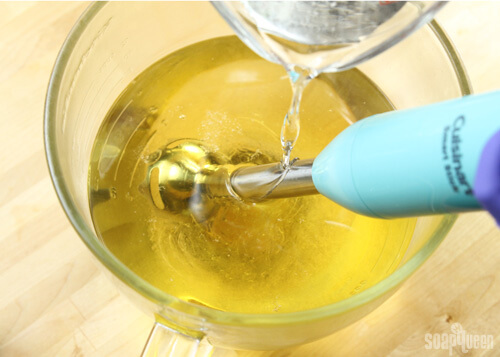
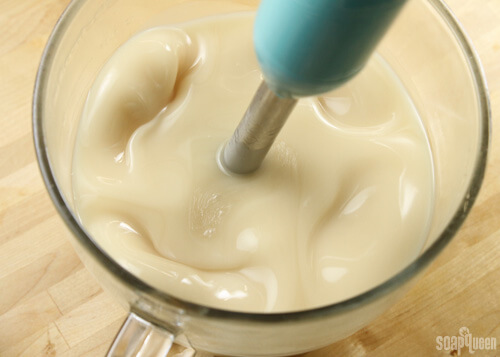 THREE: Once the batter has reached a light trace, split the batch in half. Each container will be about 4 cups.
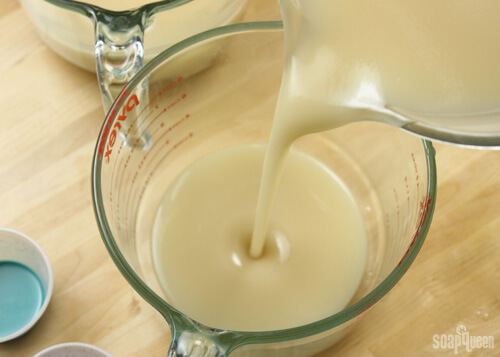 FOUR: Add 2 tbs. of Aqua Pearl Mica into one container, and 1 tbs. of Ultramarine Blue into the other. Use a whisk to gently combine.
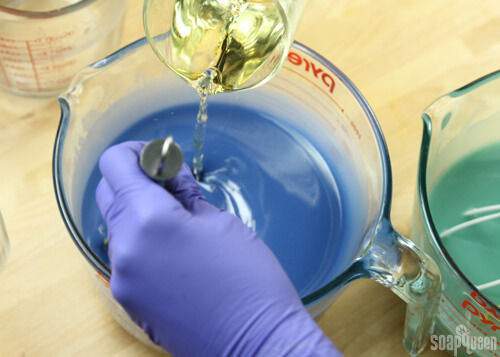
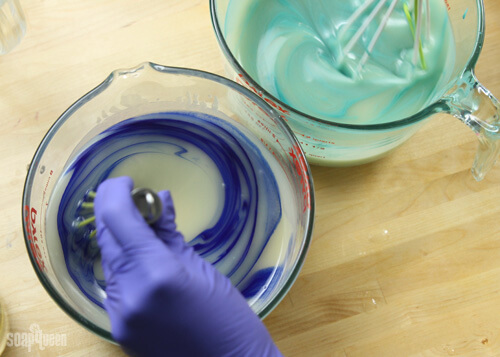 FIVE: Add half of the Ocean Rain and Pineapple Cilantro Fragrance Oil blend into each container. You can eyeball it! Use a whisk to mix in.
 SIX: Gently pour both colors of soap into the two Multi-Pour Sectioning Tool. To help the soap batter evenly spread throughout the sections, you can alternate pouring from each end.
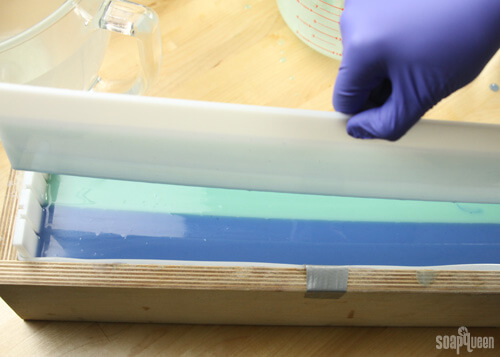
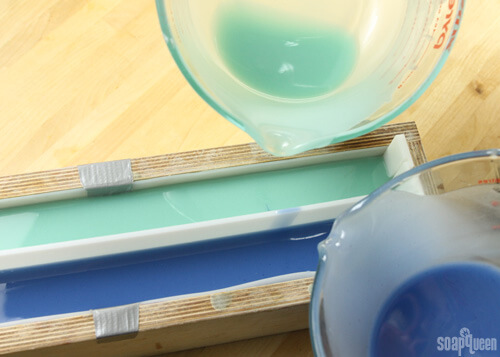 SEVEN: Once the sections are full, slowly remove the center divider straight up and out of the soap. Gently tap down the mold to disperse any bubbles.
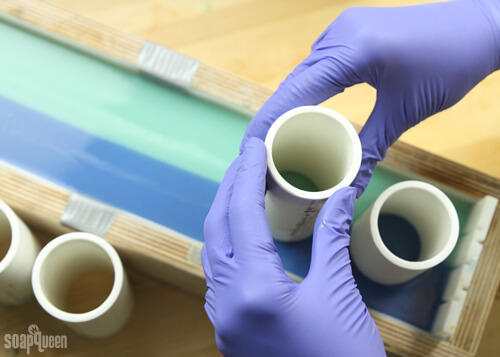
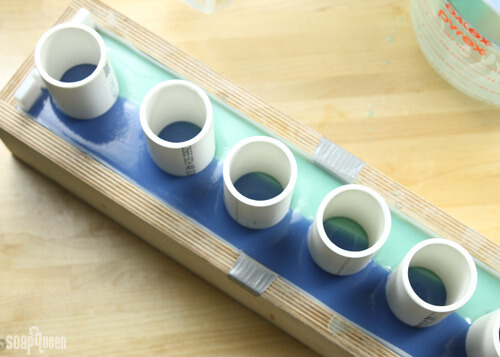
 EIGHT: Gently push the PVC pipes into the center of the soap. Make sure there is space between each pipe, and between the mold and the pipes on the ends.
 NINE: Spray with 99% isopropyl alcohol to prevent soda ash. Let soap in the mold for 3-4 days before attempting to remove the pipes. The pipes should be fairly easy to pull up and out of the soap. If not, give them more time. If after three to four days the pipes are still difficult to remove, place the soap into the freezer for 3-4 hours. Remove from the freezer, and attempt to remove the pipes again after a few hours. Patience is key.
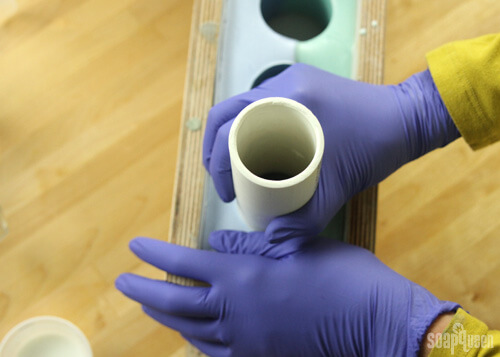
The amount of soap needed to fill the negative space may be different from this tutorial, depending on how large your pipes are. To find the amount of total soap needed to fill the holes, place all the embeds on a scale. The weight of the embeds are approximately how much soap you need to make. You may want to create an additional couple ounces of soap to ensure you have enough.
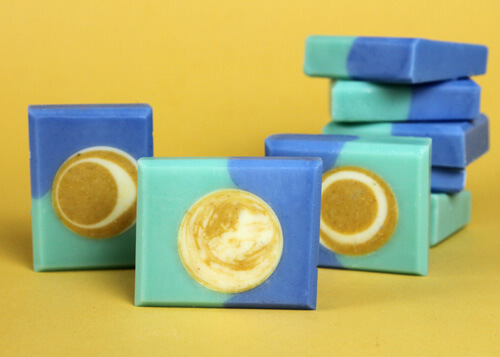
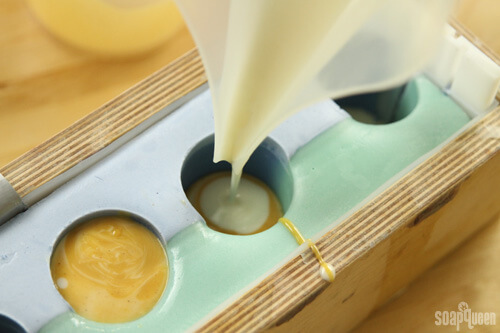
For this soap, both an In-The-Pot-Swirl and an alternating drop swirl technique are shown. As you can see from the final photos, each swirl technique results in a very different bar of soap. You can decide to do both styles of swirl and alternate filling the holes, or you can choose one to use throughout the entire loaf.
SAFETY FIRST: Suit up for safe handling practices! That means goggles, gloves and long sleeves. Make sure kids, pets, and other distractions and tripping hazards are out of the house or don’t have access to your soaping space. Always soap in a well-ventilated area.
COLOR PREP: To ensure that the Titanium Dioxide blends smoothly into the soap batter, we recommend micronizing it before dispersing it in oil. Please note this is an optional tip but it does help with the titanium dioxide clumping in the soap =) To micronize colorant, simply use a coffee grinder to blend the colorant to break up any clumps of color and prevent streaks of white from showing in the final soap. We like to use a coffee grinder that has a removable, stainless steel mixing area for easy cleaning. Then, disperse 1 teaspoons of the colorant into 1 tablespoons of sunflower or sweet almond oil (or any other liquid oil). Finally, disperse 1 teaspoon of the Yellow Oxide into 1 tablespoon of sunflower or sweet almond oil (or any other liquid oil). Disperse 2 teaspoons Orange Peel into 2 tablespoons of light liquid oil. Use a mini mixer to get the clumps of color worked out smoothly.
FRAGRANCE BLEND: In a small glass container, measure 1 oz. Orange Peel Cybilla Fragrance Oil and set aside.
ONE: Combine the coconut oil, olive oil, avocado and palm oils (remember to fully melt then mix your entire container of palm oil before portioning). Once the lye water and the oils have cooled to 130 ° F or below (and are ideally within 10 degrees of each other), add the lye water to the oils and stick blend until thin trace.
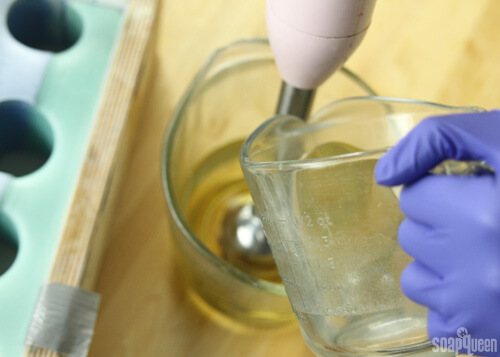 TWO: To one container, add 1/2 tsp. Yellow Oxide and 2 tbs. orange peel. The Orange Peel adds gentle exfoliation, and a texturized look. To the other container, add all of the Titanium Dioxide. Use a whisk to thoroughly incorporate pigments.
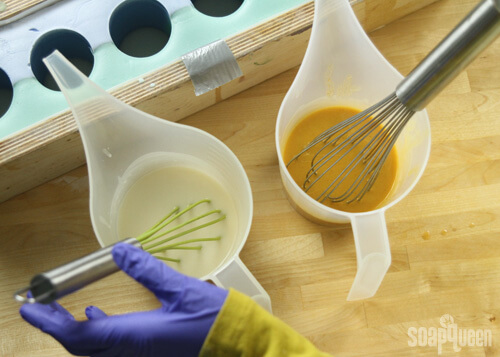 THREE: Add one half of the Orange Peel Cybilla Fragrance Oil to each container. No need to measure, you can eyeball it. Use a whisk to fully incorporate.
 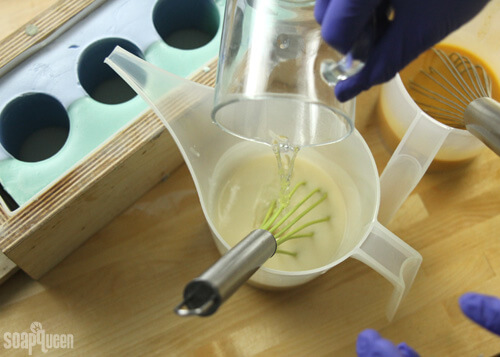 THREE: Time to choose what swirl technique to use! If you prefer the alternating drop swirl, move on to “step five.” If you prefer the In-The-Pot-Swirl, move on to the next step.
FOUR: To create an In-The-Pot-Swirl, pour the white soap into the container containing the yellow soap at three different points: 12:00 o’clock, 4:00 o’clock and 8:00 o’clock. Pour the soap from a high point to ensure the soap penetrates through the entire container. Use a dowel to swirl the soap by running the dowel through all three pouring points. Only stir once! You want to swirl it, but not blend it completely. 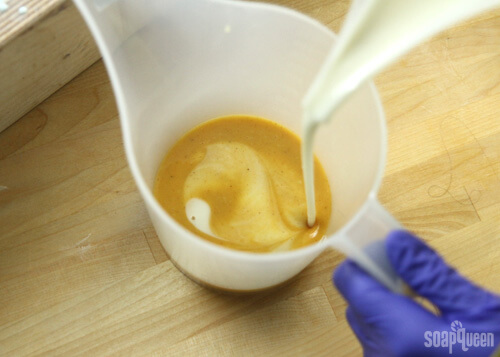 FIVE: Slowly pour the soap into the holes. Once full, spray with 99% isopropyl alcohol to help prevent soda ash. Unmold after 3-4 days. Allow to cure for 4-6 weeks and enjoy!
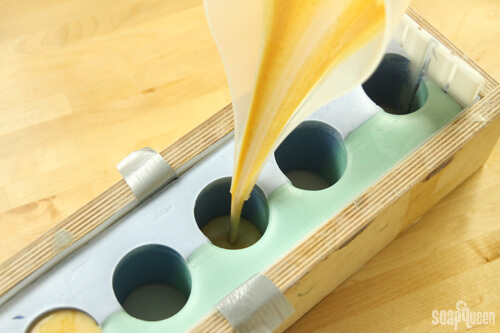 SIX: For the drop swirl, alternate pouring the orange and yellow soap into the same hole using 3 second pours. Once full, spray with 99% isopropyl alcohol to help prevent soda ash. Unmold after 3-4 days. Allow to cure for 4-6 weeks and enjoy!
 When it’s time to cut, you can cut the loaf in the traditional way, but in order to achieve the results shown in the photos, the bars need to be cut horizontally. If you’re not sure how to cut bars horizontally, there’s a video for that here.
Have you tried the negative embed soaping technique yet? I’m excited to experiment with it more! In fact, a new negative embed soap was created yesterday =)
