




• October 27, 2013

Shorter days and longer nights don’t have to be a bad thing — hopefully that means more time to spend with family and maybe even more time to soap! If you’re looking for some stunning natural colorants that can be used in both cold process and melt & pour recipes, you will be interested in these new colorants that have been added to the Bramble Berry line: Brazilian Clays. Our Brazilian Clays are versatile, natural, beautiful and non-bleeding.
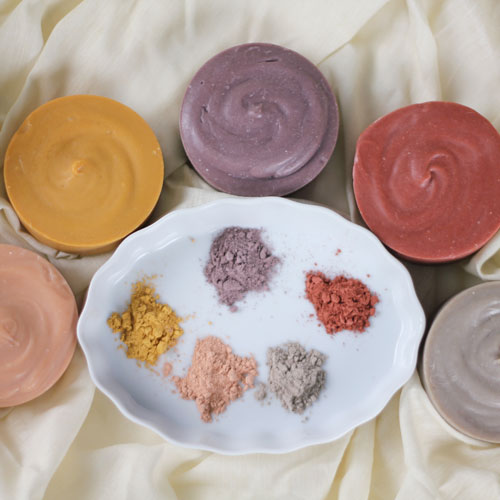
These clays are naturally colored and do not contain any artificial dyes or pigments. The various shades are actually achieved by variations in the minerals found in the soil in the different regions of Brazil. Bramble Berry carries five different natural clays — Natural Brazilian, Purple, Yellow, Pink and Dark Red.You can buy each color individually, or buy all five at once in our Brazilian Clay Sampler.

The clays are stable in cold process soaps and make a great addition to any clay mask or cream. Clays can be a bit tricky if you haven’t used them before, and you’ll need some additional preparation before using them in your cold-process soaps. Clays are incredibly absorbent and tend to accelerate trace when added dry. They can also cause cracking if they aren’t dispersed first. To prevent this, disperse your clays in distilled water using a mini-mixer. You can use a ratio of 1 teaspoon of clay to 1 tablespoon of water per color. Make sure that the clay is completely saturated with water before mixing or you might end up with a messy cloud of clay.

If you are making melt & pour and want to add any of Bramble Berry’s clays without clumping or settling, we suggest dispersing the clay in a small amount of rubbing alcohol before adding it to your batch. We recommend a dispersion ratio of 2 teaspoons of clay to 1 tablespoon of alcohol. To learn more about natural colorants in melt & pour, check out this blog post.

Below are some fun tutorials that include our Brazilian Clays. If you get a chance to try out the different colors (Natural, Purple, Yellow, Pink, & Dark Red), we’d love for you to leave us a review on the product’s page or share a picture with us on Bramble Berry’s Facebook page. Happy soaping!
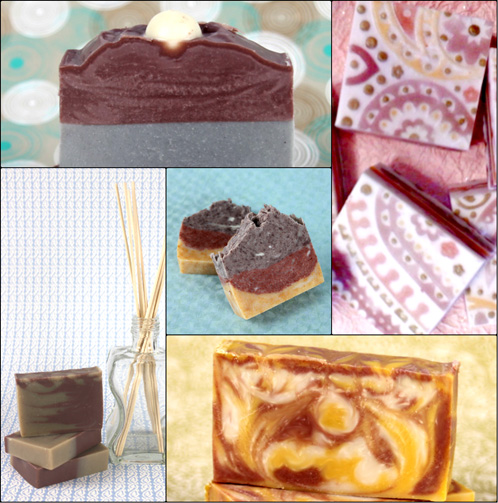
Top Left – Clockwise: Cute as a ButtonUnder Your Spell – Melt and Pour Clay TutorialTiger Stripe “Hanger” Swirl TutorialIn-The-Pot SwirlHot Process Series: Oven Process Layers


You may also like these

Become an email subscriber

Enter your email address below and you will receive all our new posts directly in your email inbox.

  1. Is the water that you use to mix the clay into in addition to the water used in the lye mixture? In other words, do you use water from the original recipe for mixing the clays or is the clay water considered additional water, on top of the original recipe? Thanks!

    1. Hi Amanda!

      It depends on how much clay you’re using! For instance, if you’re just adding a little bit of dispersed clay (1 teaspoon to 1 tablespoon) you don’t need to water discount. However, if you’re adding quite a bit of dispersed clay to your batch, say a couple ounces, you may want to water discount. The extra water can make your batch a bit softer, and prolong the curing process slightly. In that case, a water discount would be helpful. 🙂

      -Kelsey with Bramble Berry

  2. I added some clay pre-mixed with alcohol to an olive oil M&P base, and still had some clumping. 🙁 In fact, it turned out quite ugly! Lol…it’s got some crushed walnut shells and orange peel powder in it and is scented with Shave & a Haircut fragrance oil. I’m calling it Dirty Man Soap. I still love it, but the color/aesthetics leave a lot to be desired. Have you guys ever posted any of your soap “disasters”? I would love to see them! 😀

    1. Hi Nicole!

      Because clay particles are a bit larger, clumping can occur! It helps to mix the clay and alcohol really well with a mini mixer. Then, pour that in. However, if you notice clumps of clay at the bottom, don’t pour that in! Those bits can clump up in the soap. Then, stir the clay mixture in the soap for a good 1-2 minutes to get everything incorporated. It can also help to increase the ratio to 1 teaspoon clay, 3 tablespoons alcohol. The extra alcohol will evaporate and help disperse the color. 🙂

      See how to incorporate clay in the Charcoal and Rose Clay Spa Bar: https://soapqueen.com/bath-and-body-tutorials/melt-and-pour-soap/charcoal-rose-clay-spa-bar/

      Mini mixer: https://www.brambleberry.com/Mini-White-Plastic-Mixer-P4721.aspx

      However, that bar is still totally usable! The clay adds some great exfoliation, and gives the bar a beautiful rustic look. 🙂

      Also, we definitely experience soapy mishaps! We try to test our recipes thoroughly to ensure the tutorials can be recreated easily. Because of this, we sometimes have to make the recipe several times. You can read more about that in the If At First You Don’t Succeed, Soap Soap Again post: https://soapqueen.com/bath-and-body-tutorials/tips-and-tricks/first-dont-succeed-soap-soap/

      -Kelsey with Bramble Berry

  3. Hi,
    I was wondering if I wanted to add clay into melt and pour soap, can I disperse the clay with water? will it affect the soap? And if I wanted to add clay in cold process soap, is there any difference if i disperse the clay with alcohol instead of water?
    Im just curious about why we should disperse the clay with alcohol in melt and pour but water in cold process.
    Thanks.

    1. Hi Joon!

      We recommend mixing the clay with alcohol in melt and pour because it helps the clay mix in evenly and then evaporates! That means the texture of your melt and pour won’t be affected. You can mix the clay in water, but adding a lot of excess water to your melt and pour can make the soap crumbly, oily or greasy.

      Also, alcohol and cold process soap don’t mix! Alcohol can cause your soap to accelerate quite a bit and do other weird things. We recommend using distilled water for cold process, and alcohol for melt and pour. 🙂

      -Kelsey with Bramble Berry

      99% isopropyl alcohol: https://www.brambleberry.com/Isopropyl-Alcohol-99-16-oz-P5682.aspx

      1. Hi Kelsey,
        Thanks a lot for your explanation.
        May I know when should I add in the clay during CP? Should I mix it into carrier oils first before I add in lye solution or after i get a trace/before pour into soap mold?
        I’ve read from another website which suggest adding the clay directly to the water before adding lye. Since the lye solution is HOT, it will actually extract the mineral color more effectively from the clay and we can use FAR LESS clay in our soap formula and get quite intense colors. Is this true?
        Thanks.

        1. Hi Joon!

          We typically mix 1 tsp. of clay with 1 Tbsp. of distilled water. Then, we add that mixture at trace and mix in with a whisk.

          We haven’t done a lot of testing with adding the clay into your water before adding the lye. If you do try that method, let us know how it works for you! 🙂

          -Kelsey with Bramble Berry

          1. Hi Kelsey,
            Thanks a lot. Would definitely try on that and if it turns out well, will share it here.
            Have a nice day.

          2. You’re welcome! Can’t wait to hear how it goes. Have a great day too. 🙂

            -Kelsey with Bramble Berry

    1. Hi Renee!

      I would recommend mixing the clay with a liquid oil or your fragrance oil beforehand. Then, add that to your recipe and mix will. Mixing it with the oil beforehand would help prevent any clumping. 🙂

      -Kelsey with Bramble Berry

  4. Hello, thanks for this info. if I wanted to colour melt and pour soap with a clay, would it be ok to disperse it with a little natural oil instead of rubbing alcohol, or would only the rubbing alcohol work?

    1. Hi Amanda!

      You can use oil, but because our Melt and Pour Bases are already made up it may affect the texture of your finished product.

      Mixing the clay with alcohol is nice because it disperses the clay and evaporates, leaving no residue. 🙂

      -Kelsey with Bramble Berry

  5. Hello! I’ve been having such a great time with the clays. They make my bars nice and hard with a soft creamy lather. I recently ran across white french clay and was wondering if I could use this instead of TD (as a whitening colorant). Do you think it would be as whitening as TD?

    ~Evie

    1. Good morning, Evie!

      You could definitely try out this new clay you have purchased, and we’d love to hear how it turns out for you. We are always on the look out for new ingredients for our soapmaking! =)

      -Becky with Bramble Berry

  6. I was wondering if anyone knew how to get a professional label on lip balm display boxes with an arch. I have mine, and the rectangular portion is 1.9″ x 3.125, and the half circle on the top of it (arched portion) has a 2.125″ diameter. Not sure how to label these without combining a circle and a rectangle (I don’t like this idea) Can anyone help?

    1. Hi Gabi!

      It really depends on what size boxes you have, but you can check out our free labels (for all sorts of products) here:

      https://www.brambleberry.com/Search.aspx?k=label

      I would also suggest checking out the Teach Soap Forums to see if any of the crafters or soapers there have some ideas for you.

      http://www.teachsoap.com/forum/

      And, Avery does have labels that work on a variety of different types of boxes and packaging. I would also contact the vendor you bought the boxes from to see if they had any additional ideas! 🙂

      -Becky with Bramble Berry

  7. I ordered the Soap Guild goodie bag and am making the Cute as a Button soap. But the instructions list the lavendar essential oil twice which I assume is just a mistake. I measured out the purple brazilian clay and only got a teaspoon. The instructions say 2 tsp is needed for Cute as a button. The In-the-Pot Swirl soap calls for 1/2 tsp of the red brazilian clay but got like 2-3 tsp in the goodie bag. So are the instructions wrong or did someone mix up how much I should be getting of each when it was packaged?

    1. Good morning, Jeanne!

      Thanks for the eagle-eye. I’ve edited the Soap Guild Conference Goodie Bag to take out the double Lavender Essential Oils in the instructions. I’m going to talk to the team and make sure the rest of the instructions are clear and that everyone who orders the kit is getting what they are supposed to! It looks like you might have gotten a little extra of the Red Brazilian Clay, and we’d love for you to contact customer service so that they can get everything figure out for you! You can reach them by email at info(at)brambleberry(dot)com or toll-free at 1-877-627-7883. Thank you so much for making us aware of this! =)

      -Becky with Bramble Berry

    1. Hi Lesli!

      Could you tell us more about your recipe so we can help you troubleshoot? We’ve found the Brazilian Purple to always give us a gorgeous purple color and we want to help you get that same one as well! =)

      -Becky with Bramble Berry

        1. Hi Lesli!

          If you are using a higher content Olive Oil recipe, you will find that sometimes your colors can morph and change a tad because of the yellow-green color of the Olive Oil. If you want it to be more purple, we would suggest lowering the Olive Oil content and you will see more of a purple color begin to come through. I hope that this helps! =)

          You can also use Periwinkle LabColor, Purple LabColor, or the Ultramarine Violet for a fun purple color in your soaps.

          Periwinkle High pH LabColor: https://www.brambleberry.com/Periwinkle-High-pH-LabColor-P4328.aspx

          Purple Passion LabColor: https://www.brambleberry.com/Purple-Passion-LabColor-P3483.aspx

          Ultramarine Violet Oxide Pigment: https://www.brambleberry.com/Ultramarine-Violet-Oxide-Pigment-P4047.aspx

          -Becky with Bramble Berry

  8. This is exciting! I can’t wait to try all the different colors — they’re so beautiful! 🙂

    1. Hi Becky!

      We can’t wait for you to try these clays out either, be sure to post pictures of your soapy creations made with them on Bramble Berry’s Facebook page. =)

      Happy Soaping!
      -Becky with Bramble Berry

    1. Good morning, Elaine!

      When using clay in melt & pour soaps, you would disperse it in rubbing alcohol before adding it to your melted soap base. You can actually add the fragrance right to the melted soap base to get it fully mixed in! =)}

      -Becky with Bramble Berry

    1. Hi Erin!

      You are correct! The Brazilian Clays and their shades
      are achieved by variations of the minerals and oligoelements found in the soil in the different regions of Brazil.There is no added colorants and they are all natural! We hope you get a chance to check them out and use them in your soaps. =)

      -Becky with Bramble Berry

    1. Hi Kimberly!

      To get these vibrant colors you can use 1 teaspoon per pound of soap. For that picture, each of those soaps weigh about 4 ounces and we used 1/4 of a teaspoon of clay in each. Be sure to experiment to get a color and hue that you like as clays are a WYSIWYG (What You See Is What You Get) type of colorant. =)

      Happy Soaping!
      -Becky with Bramble Berry

Comments are closed.

{"email":"Email address invalid","url":"Website address invalid","required":"Required field missing"}

The Latest from Soap Queen TV

Inspired by Gems & Crystals

All About Essential Oils

The Power of Charcoal

Create Your Own Clay Face Mask

DIY Bath Bombs

Cold Process Soap Tips & Tricks

Learn the Basics of Cold Process Soapmaking

Learn the Basics of Melt & Pour Soapmaking

Want to Start Your Own Soap Business?

Soap Business Success Stories

Soap Queen TV Favorites

Ingredient Spotlight

Disclosure

Unless stated otherwise, all images are original material and are copyrighted. If you'd like to use an image, please be a friend and credit the photo and link back to Soap Queen. Feel free to share, tweet and pin to your hearts content.